Server Error Try Again When I Try to Update Google Business
This folio describes troubleshooting methods for mutual errors you may meet while using Cloud Storage.
See the Google Cloud Status Dashboard for information almost regional or global incidents affecting Google Deject services such as Cloud Storage.
Logging raw requests
When using tools such every bit gsutil or the Cloud Storage customer libraries, much of the request and response information is handled by the tool. However, it is sometimes useful to run across details to assist in troubleshooting. Use the following instructions to return asking and response headers for your tool:
Console
Viewing request and response information depends on the browser you're using to admission the Google Deject Panel. For the Google Chrome browser:
-
Click Chrome's primary card button (
 ).
). -
Select More Tools.
-
Click Programmer Tools.
-
In the pane that appears, click the Network tab.
gsutil
Employ the global -D flag in your request. For case:
gsutil -D ls gs://my-bucket/my-object
Client libraries
C++
-
Set up the environment variable
CLOUD_STORAGE_ENABLE_TRACING=httpto get the full HTTP traffic. -
Set the surround variable CLOUD_STORAGE_ENABLE_CLOG=yes to become logging of each RPC.
C#
Add together a logger via ApplicationContext.RegisterLogger, and set up logging options on the HttpClient message handler. For more information, see the FAQ entry.
Go
Prepare the environment variable GODEBUG=http2debug=1. For more information, see the Get package net/http.
If y'all want to log the asking trunk equally well, use a custom HTTP client.
Java
-
Create a file named "logging.backdrop" with the post-obit contents:
# Properties file which configures the operation of the JDK logging facility. # The system will await for this config file to be specified as a arrangement property: # -Djava.util.logging.config.file=${project_loc:googleplus-simple-cmdline-sample}/logging.properties # Gear up the panel handler (uncomment "level" to testify more fine-grained messages) handlers = coffee.util.logging.ConsoleHandler java.util.logging.ConsoleHandler.level = CONFIG # Fix upwardly logging of HTTP requests and responses (uncomment "level" to show) com.google.api.customer.http.level = CONFIG -
Use logging.backdrop with Maven
mvn -Djava.util.logging.config.file=path/to/logging.backdrop insert_command
For more information, encounter Pluggable HTTP Transport.
Node.js
Ready the environment variable NODE_DEBUG=https earlier calling the Node script.
PHP
Provide your ain HTTP handler to the client using httpHandler and set up up middleware to log the asking and response.
Python
Use the logging module. For example:
import logging import http.client logging.basicConfig(level=logging.DEBUG) http.client.HTTPConnection.debuglevel=five
Carmine
At the acme of your .rb file afterwards crave "google/cloud/storage", add the following:
ruby Google::Apis.logger.level = Logger::DEBUG
Error codes
The following are common HTTP condition codes you may encounter.
301: Moved Permanently
Upshot: I'1000 setting up a static website, and accessing a directory path returns an empty object and a 301 HTTP response code.
Solution: If your browser downloads a zippo byte object and you get a 301 HTTP response lawmaking when accessing a directory, such as http://www.example.com/dir/, your bucket most likely contains an empty object of that name. To check that this is the case and set the event:
- In the Google Deject Console, go to the Cloud Storage Browser page.
Get to Browser
- Click the Activate Cloud Beat out button at the peak of the Google Cloud Panel.

- Run
gsutil ls -R gs://www.example.com/dir/. If the output includeshttp://www.case.com/dir/, you have an empty object at that location. - Remove the empty object with the command:
gsutil rm gs://www.example.com/dir/
You can at present access http://www.example.com/dir/ and have it return that directory'southward index.html file instead of the empty object.
400: Bad Request
Issue: While performing a resumable upload, I received this mistake and the message Failed to parse Content-Range header.
Solution: The value you used in your Content-Range header is invalid. For example, Content-Range: */* is invalid and instead should be specified as Content-Range: bytes */*. If y'all receive this error, your current resumable upload is no longer agile, and you must start a new resumable upload.
Issue: Requests to a public bucket directly, or via Cloud CDN, are declining with a HTTP 401: Unauthorized and an Hallmark Required response.
Solution: Check that your client, or any intermediate proxy, is not calculation an Authority header to requests to Cloud Storage. Any request with an Authorisation header, fifty-fifty if empty, is validated every bit if it were an authentication attempt.
403: Account Disabled
Effect: I tried to create a bucket just got a 403 Account Disabled mistake.
Solution: This error indicates that you have not notwithstanding turned on billing for the associated project. For steps for enabling billing, see Enable billing for a projection.
If billing is turned on and you lot continue to receive this mistake message, y'all tin can attain out to support with your project ID and a description of your trouble.
403: Access Denied
Outcome: I tried to listing the objects in my bucket but got a 403 Access Denied error and/or a message similar to Anonymous caller does not have storage.objects.list access.
Solution: Cheque that your credentials are right. For instance, if you are using gsutil, check that the credentials stored in your .boto file are accurate. Besides, confirm that gsutil is using the .boto file you expect by using the command gsutil version -fifty and checking the config path(s) entry.
Bold you are using the correct credentials, are your requests being routed through a proxy, using HTTP (instead of HTTPS)? If so, bank check whether your proxy is configured to remove the Authorisation header from such requests. If and then, make sure you are using HTTPS instead of HTTP for your requests.
403: Forbidden
Issue: I am downloading my public content from storage.cloud.google.com, and I receive a 403: Forbidden error when I apply the browser to navigate to the public object:
https://storage.cloud.google.com/BUCKET_NAME/OBJECT_NAME
Solution: Using storage.cloud.google.com to download objects is known as authenticated browser downloads; it always uses cookie-based authentication, fifty-fifty when objects are made publicly attainable to allUsers. If you have configured Data Access logs in Deject Inspect Logs to runway access to objects, one of the restrictions of that feature is that authenticated browser downloads cannot be used to access the affected objects; attempting to do so results in a 403 response.
To avoid this issue, do one of the following:
- Use straight API calls, which support unauthenticated downloads, instead of using authenticated browser downloads.
- Disable the Deject Storage Information Access logs that are tracking access to the affected objects. Exist aware that Data Access logs are set at or above the project level and can be enabled simultaneously at multiple levels.
- Fix Data Access log exemptions to exclude specific users from Data Access log tracking, which allows those users to perform authenticated browser downloads.
409: Conflict
Consequence: I tried to create a bucket merely received the following error:
409 Conflict. Sorry, that name is non bachelor. Delight endeavor a unlike one.
Solution: The bucket name you tried to use (e.1000. gs://cats or gs://dogs) is already taken. Cloud Storage has a global namespace and so yous may non name a bucket with the aforementioned name as an existing bucket. Cull a name that is not being used.
429: As well Many Requests
Issue: My requests are being rejected with a 429 As well Many Requests error.
Solution: You are hitting a limit to the number of requests Cloud Storage allows for a given resource. See the Cloud Storage quotas for a word of limits in Cloud Storage. If your workload consists of 1000's of requests per second to a bucket, run into Asking rate and access distribution guidelines for a discussion of all-time practices, including ramping upwardly your workload gradually and avoiding sequential filenames.
Diagnosing Google Cloud Panel errors
Issue: When using the Google Deject Console to perform an operation, I get a generic error message. For instance, I see an mistake message when trying to delete a bucket, but I don't see details for why the operation failed.
Solution: Employ the Google Cloud Panel's notifications to see detailed information most the failed functioning:
-
Click the Notifications button in the Google Cloud Panel header.

A dropdown displays the nigh recent operations performed by the Google Cloud Panel.
-
Click the item you want to observe out more about.
A page opens up and displays detailed information about the operation.
-
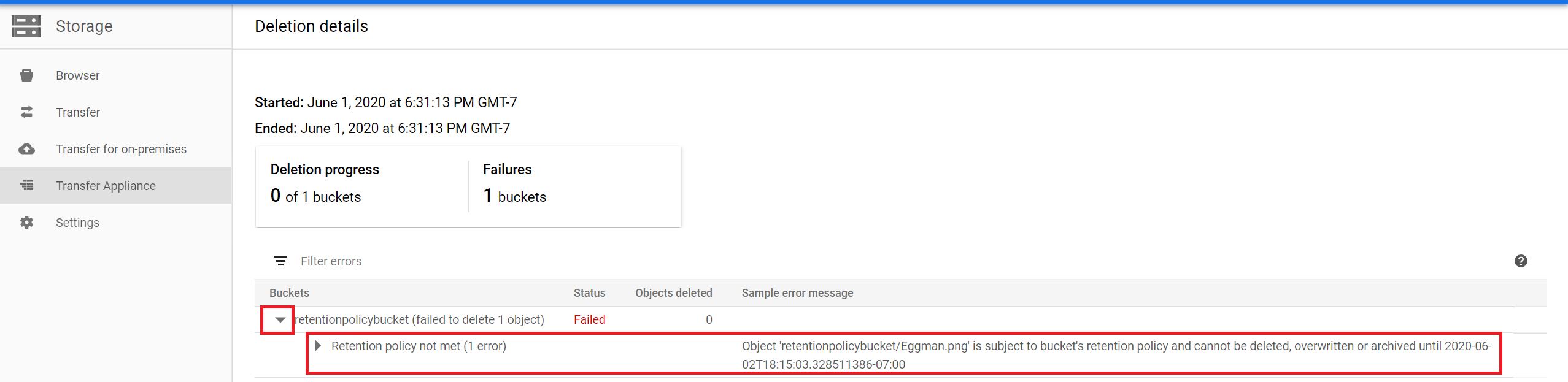
Click on each row to expand the detailed error information.
Below is an example of error information for a failed bucket deletion operation, which explains that a bucket retentiveness policy prevented the deletion of the bucket.
gsutil errors
The following are common gsutil errors you may encounter.
gsutil stat
Issue: I tried to use the gsutil stat command to display object status for a subdirectory and got an error.
Solution: Deject Storage uses a flat namespace to store objects in buckets. While you tin can utilize slashes ("/") in object names to make it appear as if objects are in a hierarchical structure, the gsutil stat control treats a trailing slash every bit part of the object name.
For example, if you run the control gsutil -q stat gs://my-bucket/my-object/, gsutil looks up information about the object my-object/ (with a trailing slash), equally opposed to operating on objects nested nether my-bucket/my-object/. Unless you actually have an object with that name, the operation fails.
For subdirectory listing, apply the gsutil ls instead.
gcloud auth
Effect: I tried to authenticate gsutil using the gcloud auth command, but I notwithstanding cannot access my buckets or objects.
Solution: Your organization may accept both the stand-lone and Google Cloud CLI versions of gsutil installed on it. Run the command gsutil version -l and cheque the value for using cloud sdk. If Faux, your system is using the stand-alone version of gsutil when you run commands. Yous tin either remove this version of gsutil from your system, or you can cosign using the gsutil config command.
Static website errors
The following are common bug that you may run across when setting upwards a saucepan to host a static website.
HTTPS serving
Effect: I want to serve my content over HTTPS without using a load balancer.
Solution: You tin serve static content through HTTPS using direct URIs such as https://storage.googleapis.com/my-saucepan/my-object. For other options to serve your content through a custom domain over SSL, you can:
- Use a tertiary-party Content Commitment Network with Cloud Storage.
- Serve your static website content from Firebase Hosting instead of Cloud Storage.
Domain verification
Event: I tin't verify my domain.
Solution: Normally, the verification procedure in Search Console directs yous to upload a file to your domain, but you may not have a way to do this without outset having an associated bucket, which you lot can just create after you accept performed domain verification.
In this case, verify ownership using the Domain name provider verification method. Run into Ownership verification for steps to attain this. This verification can exist done earlier the bucket is created.
Inaccessible page
Issue: I get an Access denied error message for a web page served by my website.
Solution: Check that the object is shared publicly. If information technology is not, come across Making Data Public for instructions on how to practice this.
If you previously uploaded and shared an object, but and then upload a new version of it, then yous must reshare the object publicly. This is because the public permission is replaced with the new upload.
Permission update failed
Issue: I become an error when I attempt to make my information public.
Solution: Brand certain that yous take the setIamPolicy permission for your object or bucket. This permission is granted, for example, in the Storage Admin office. If you take the setIamPolicy permission and yous still become an error, your bucket might exist subject area to public access prevention, which does not allow admission to allUsers or allAuthenticatedUsers. Public access prevention might be set on the bucket directly, or it might exist enforced through an system policy that is set at a higher level.
Content download
Issue: I am prompted to download my page's content, instead of being able to view it in my browser.
Solution: If you specify a MainPageSuffix as an object that does not have a web content type, so instead of serving the page, site visitors are prompted to download the content. To resolve this issue, update the content-type metadata entry to a suitable value, such as text/html. See Editing object metadata for instructions on how to do this.
Latency
The following are common latency issues you might encounter. In addition, the Google Cloud Status Dashboard provides information near regional or global incidents affecting Google Deject services such as Deject Storage.
Upload or download latency
Issue: I'm seeing increased latency when uploading or downloading.
Solution: Use the gsutil perfdiag control to run performance diagnostics from the affected environment. Consider the following mutual causes of upload and download latency:
-
CPU or memory constraints: The affected environment's operating system should have tooling to measure local resource consumption such as CPU usage and retention usage.
-
Disk IO constraints: Equally part of the
gsutil perfdiagcontrol, utilise therthru_fileandwthru_filetests to gauge the performance impact acquired past local disk IO. -
Geographical distance: Operation tin be impacted by the physical separation of your Deject Storage saucepan and affected environs, particularly in cross-continental cases. Testing with a bucket located in the same region as your afflicted environment can identify the extent to which geographic separation is contributing to your latency.
- If applicable, the affected surround'southward DNS resolver should apply the EDNS(0) protocol so that requests from the environment are routed through an advisable Google Front Stop.
gsutil or customer library latency
Event: I'grand seeing increased latency when accessing Cloud Storage with gsutil or one of the customer libraries.
Solution: Both gsutil and customer libraries automatically retry requests when it's useful to exercise and then, and this behavior tin can effectively increase latency every bit seen from the finish user. Use the Cloud Monitoring metric storage.googleapis.com/api/request_count to run into if Cloud Storage is consistenty serving a retryable response code, such as 429 or 5xx.
Proxy servers
Result: I'm connecting through a proxy server. What do I need to do?
Solution: To access Cloud Storage through a proxy server, you must permit access to these domains:
-
accounts.google.comfor creating OAuth2 authentication tokens viagsutil config -
oauth2.googleapis.comfor performing OAuth2 token exchanges -
*.googleapis.comfor storage requests
If your proxy server or security policy doesn't support whitelisting by domain and instead requires whitelisting by IP network block, we strongly recommend that you configure your proxy server for all Google IP address ranges. Y'all tin notice the address ranges by querying WHOIS data at ARIN. As a all-time practice, you lot should periodically review your proxy settings to ensure they match Google's IP addresses.
We do not recommend configuring your proxy with private IP addresses you obtain from one-time lookups of oauth2.googleapis.com and storage.googleapis.com. Because Google services are exposed via DNS names that map to a large number of IP addresses that tin modify over time, configuring your proxy based on a one-fourth dimension lookup may atomic number 82 to failures to connect to Deject Storage.
If your requests are existence routed through a proxy server, you may demand to cheque with your network administrator to ensure that the Authorization header containing your credentials is not stripped out by the proxy. Without the Authorization header, your requests are rejected and you receive a MissingSecurityHeader fault.
What'south next
- Larn nearly your support options.
- Detect answers to boosted questions in the Cloud Storage FAQ.
- Explore how Error Reporting can help yous identify and empathise your Deject Storage errors.
Source: https://cloud.google.com/storage/docs/troubleshooting
0 Response to "Server Error Try Again When I Try to Update Google Business"
Post a Comment