Etween the Waves Feminist Positions in American Art 194962
2nd-wave feminism was a period of feminist action that began in the early on 1960s and lasted roughly two decades. It took identify throughout the Western globe, and aimed to increase equality for women by building on previous feminist gains.
Whereas get-go-wave feminism focused mainly on suffrage and overturning legal obstacles to gender equality (east.thou., voting rights and holding rights), 2d-wave feminism broadened the debate to include a wider range of problems: sexuality, family unit, domesticity, the workplace, reproductive rights, de facto inequalities, and official legal inequalities.[1] It was a movement that was focused on critiquing the patriarchal, or male-dominated, institutions and cultural practices throughout society.[2] Second-wave feminism also drew attention to the problems of domestic violence and marital rape, created rape-crisis centers and women'south shelters, and brought virtually changes in custody laws and divorce law. Feminist-endemic bookstores, credit unions, and restaurants were among the primal meeting spaces and economic engines of the movement.[iii]
The term "second-wave feminism" itself was brought into common parlance by journalist Martha Lear in a New York Times Magazine article in March 1968 titled "The Second Feminist Wave: What do These Women Desire?".[4] She wrote, "Proponents call it the Second Feminist Wave, the first having ebbed afterwards the glorious victory of suffrage and disappeared, finally, into the great sandbar of Togetherness."[iv] : 323
Many historians view the second-wave feminist era in America as ending in the early 1980s with the intra-feminism disputes of the feminist sex wars over issues such as sexuality and pornography, which ushered in the era of third-wave feminism in the early 1990s.[5]
Overview in the U.s.a. [edit]
The second wave of feminism in the United states of america came every bit a delayed reaction against the renewed domesticity of women after Earth War II: the belatedly 1940s mail service-war boom, which was an era characterized past an unprecedented economic growth, a baby smash, a move to family-oriented suburbs and the ideal of companionate marriages. During this fourth dimension, women did not tend to seek employment due to their engagement with domestic and household duties, which was seen equally their primary duty but often left them isolated inside the dwelling house and estranged from politics, economics, and police making. This life was clearly illustrated by the media of the time; for instance television shows such as Father Knows Best and Exit Information technology to Beaver idealized domesticity.[6]
Some of import events laid the groundwork for the 2d wave, specifically the piece of work of French author Simone de Beauvoir in the 1940s where she examined the notion of women beingness perceived as "other" in the patriarchal society. Simone de Beauvoir is an existentialist significant she believed in the beingness of the individual person as a free and responsible agent determining their ain development through acts of the will. She went on to conclude in her 1949 treatise The 2nd Sex that male-centered ideology was existence accepted every bit a norm and enforced past the ongoing development of myths, and that the fact that women are capable of getting significant, lactating, and menstruating is in no fashion a valid crusade or explanation to place them as the "2nd sex activity".[7] This volume was translated from French to English (with some of its text excised) and published in America in 1953.[eight]
In 1960, the Food and Drug Administration canonical the combined oral contraceptive pill, which was made bachelor in 1961.[9] This made it easier for women to take careers without having to get out due to unexpectedly condign pregnant. Information technology besides meant immature couples would not be routinely forced into unwanted marriages due to adventitious pregnancies.
Though information technology is widely accepted that the movement lasted from the 1960s into the early on 1980s, the exact years of the motility are more difficult to pinpoint and are often disputed. The motility is ordinarily believed to have begun in 1963, when Betty Friedan published The Feminine Mystique, and President John F. Kennedy'south Presidential Commission on the Condition of Women released its report on gender inequality.
| External video | |
|---|---|
 | |
 Prospects of Mankind with Eleanor Roosevelt; What Status For Women?, 59:07, 1962. Prospects of Mankind with Eleanor Roosevelt; What Status For Women?, 59:07, 1962.Eleanor Roosevelt, chair of the Presidential Committee on the Status of Women, interviews President John F. Kennedy, Secretary of Labor Arthur Goldberg and others, Open Vault from WGBH[x] |
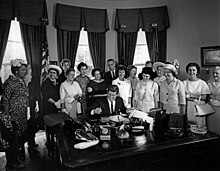
The assistants of President Kennedy made women's rights a key effect of the New Frontier, and named women (such as Esther Peterson) to many loftier-ranking posts in his administration.[eleven] Kennedy too established a Presidential Committee on the Status of Women, chaired past Eleanor Roosevelt and comprising chiffonier officials (including Peterson and Chaser General Robert F. Kennedy), senators, representatives, businesspeople, psychologists, sociologists, professors, activists, and public servants.[12] The report recommended changing this inequality past providing paid maternity leave, greater access to instruction, and help with child intendance to women.[13]
There were other actions by women in wider club, presaging their wider date in politics which would come with the second wave. In 1961, l,000 women in 60 cities, mobilized by Women Strike for Peace, protested above ground testing of nuclear bombs and tainted milk.[fourteen] [xv]
In 1963, Betty Friedan, influenced by Simone de Beauvoir's ground-breaking, feminist The Second Sex, wrote the bestselling book The Feminine Mystique. Discussing primarily white women, she explicitly objected to how women were depicted in the mainstream media, and how placing them at dwelling (every bit 'housewives') limited their possibilities and wasted potential. She had helped conduct a very important survey using her quondam classmates from Smith College. This survey revealed that the women who played a role at home and the workforce were more satisfied with their life compared to the women who stayed dwelling. The women who stayed home showed feelings of agitation and sadness. She concluded that many of these unhappy women had immersed themselves in the idea that they should non have any ambitions outside their dwelling house.[thirteen] Friedan described this equally "The Trouble That Has No Name".[sixteen] The perfect nuclear family image depicted and strongly marketed at the time, she wrote, did not reverberate happiness and was rather degrading for women.[17] This book is widely credited with having begun 2nd-wave feminism in the U.s..[18]
The report from the Presidential Commission on the Status of Women, along with Friedan's volume, spoke to the discontent of many women (especially housewives) and led to the formation of local, state, and federal government women'southward groups along with many independent feminist organizations. Friedan was referencing a "movement" as early on equally 1964.[nineteen]
The movement grew with legal victories such equally the Equal Pay Act of 1963, Title Seven of the Civil Rights Act of 1964, and the Griswold 5. Connecticut Supreme Court ruling of 1965. In 1966 Friedan joined other women and men to establish the National Organization for Women (Now); Friedan would be named every bit the organization'southward first president.[20]
Despite the early successes NOW accomplished nether Friedan's leadership, her decision to force per unit area the Equal Employment Opportunity Commission (EEOC) to apply Title VII of the 1964 Civil Rights Act to enforce more task opportunities among American women met with violent opposition inside the organisation.[20] Siding with arguments amongst several of the group'due south African-American members,[20] many of At present's leaders were convinced that the vast number of male African-Americans who lived below the poverty line were in demand of more chore opportunities than women within the center and upper class.[21] Friedan stepped down as president in 1969.[22]
In 1963, freelance announcer Gloria Steinem gained widespread popularity among feminists subsequently a diary she authored while working undercover as a Playboy Bunny waitress at the Playboy Social club was published equally a two-part feature in the May and June problems of Show.[23] In her diary, Steinem alleged the club was mistreating its waitresses in order to proceeds male customers and exploited the Playboy Bunnies as symbols of male person chauvinism, noting that the club's manual instructed the Bunnies that "there are many pleasing means they can employ to stimulate the gild'south liquor volume".[23] By 1968, Steinem had become arguably the most influential figure in the move and back up for legalized abortion and federally funded day-cares had get the two leading objectives for feminists.[24]
Amongst the nearly significant legal victories of the movement after the formation of At present were a 1967 Executive Club extending full affirmative action rights to women, a 1968 EEOC conclusion ruling illegal sexual practice-segregated assist wanted ads, Title Ix and the Women'southward Educational Equity Act (1972 and 1974, respectively, educational equality), Title X (1970, health and family unit planning), the Equal Credit Opportunity Act (1974), the Pregnancy Discrimination Human action of 1978, the outlawing of marital rape (although not outlawed in all states until 1993[25]), and the legalization of no-fault divorce (although not legalized in all states until 2010[26]), a 1975 constabulary requiring the U.S. Armed services Academies to acknowledge women, and many Supreme Courtroom cases such equally Reed five. Reed of 1971 and Roe five. Wade of 1973. All the same, the changing of social attitudes towards women is usually considered the greatest success of the women'due south motion. In January 2013, US Secretary of Defense Leon Panetta announced that the longtime ban on women serving in US military combat roles had been lifted.[27]
In 2013, the US Section of Defense force (DoD) announced their plan to integrate women into all combat positions by 2016.[27]
2nd-wave feminism also affected other movements, such every bit the ceremonious rights motility and the educatee'due south rights movement, as women sought equality within them. In 1965 in "Sex and Caste," a reworking of a memo they had written as staffers in civil-rights organizations SNCC, Casey Hayden and Mary King proposed that "assumptions of male superiority are as widespread and deep rooted and every much equally crippling to the woman as the assumptions of white supremacy are to the Negro," and that in the movement, as in lodge, women can observe themselves "defenseless up in a mutual-police force caste organization."[28] [29]
In June 1967, Jo Freeman attended a "gratuitous school" course on women at the University of Chicago led by Heather Booth[thirty] and Naomi Weisstein. She invited them to organize a woman's workshop at the then-forthcoming National Briefing of New Politics (NCNP), to be held over Labor Day weekend 1967 in Chicago. At that conference, a woman'southward caucus was formed (led by Freeman and Shulamith Firestone), who tried to present their own demands to the plenary session.[31] Yet, the women were told their resolution was not of import plenty for a floor discussion, and when through threatening to tie up the convention with procedural motions they succeeded in having their statement tacked to the end of the calendar, it was never discussed.[32] When the National Conference for New Politics (NCNP) Manager William F. Pepper refused to recognize any of the women waiting to speak and instead chosen on someone to speak almost American Indians, five women, including Firestone, rushed the podium to need to know why.[32] But Willam F. Pepper allegedly patted Firestone on the caput and said, "Move on little daughter; we have more important problems to talk about here than women's liberation", or possibly, "Cool down, trivial girl. Nosotros have more of import things to talk about than women's problems."[31] [32] Freeman and Firestone called a meeting of the women who had been at the "free school" course and the women's workshop at the briefing; this became the commencement Chicago women's liberation group. Information technology was known as the Westside grouping because information technology met weekly in Freeman's apartment on Chicago'south westward side. Later a few months, Freeman started a newsletter which she called Vocalization of the women's liberation movement. Information technology circulated all over the state (and in a few foreign countries), giving the new move of women's liberation its name. Many of the women in the Westside group went on to start other feminist organizations, including the Chicago Women'due south Liberation Union.
In 1968, an SDS organizer at the Academy of Washington told a meeting about white higher men working with poor white men, and "[h]east noted that sometimes after analyzing societal ills, the men shared leisure time by 'balling a chick together.' He pointed out that such activities did much to raise the political consciousness of poor white youth. A woman in the audience asked, 'And what did it do for the consciousness of the chick?'" (Hole, Judith, and Ellen Levine, Rebirth of Feminism, 1971, pg. 120).[32] After the meeting, a handful of women formed Seattle'southward kickoff women's liberation group.[32]
Some black feminists who were active in the early second-moving ridge feminism include civil rights lawyer and author Florynce Kennedy, who co-authored one of the first books on abortion, 1971's Ballgame Rap; Cellestine Ware, of New York's Stanton-Anthony Brigade; and Patricia Robinson. These women "tried to evidence the connections betwixt racism and male person authorization" in club.
The Indochinese Women's Conferences (IWC) in Vancouver and Toronto in 1971, demonstrated the interest of a multitude of women's groups in the Vietnam Antiwar motion. Lesbian groups, women of color, and Vietnamese groups saw their interests mirrored in the anti-imperialist spirit of the conference. Although the IWC used a Canadian venue, membership was primarily equanimous of American groups.[33]
The 2nd wave of the feminist move also marks the emergence of women's studies as a legitimate field of study. In 1970, San Diego State University was the kickoff university in the United States to offer a option of women's studies courses.[34]
The 1977 National Women'southward Conference in Houston, Texas, presented an opportunity for women's liberation groups to accost a multitude of women's issues. At the briefing, delegates from effectually the state gathered to create a National Plan of Action,[35] which offered 26 planks on matters such as women'due south health, women's employment, and child intendance.[36]

By the early 1980s, it was largely perceived that women had met their goals and succeeded in changing social attitudes towards gender roles, repealing oppressive laws that were based on sexual activity, integrating the "boys' clubs" such every bit military machine academies, the United States Armed Forces, NASA, single-sexual activity colleges, men's clubs, and the Supreme Court, and making gender discrimination illegal. Notwithstanding, in 1982, adding the Equal Rights Amendment to the United states of america Constitution failed, having been ratified by only 35 states, leaving it three states short of ratification.[37]
Second-wave feminism was largely successful, with the failure of the ratification of the Equal Rights Subpoena and Nixon's veto of the Comprehensive Child Evolution Bill of 1972 (which would have provided a multibillion-dollar national mean solar day care arrangement) the only major legislative defeats. Efforts to ratify the Equal Rights Amendment have continued. Ten states take adopted constitutions or constitutional amendments providing that equal rights nether the police shall not be denied because of sex, and well-nigh of these provisions mirror the broad linguistic communication of the Equal Rights Amendment. Furthermore, many women's groups are still agile and are major political forces. Equally of 2011[update], more women earn bachelor's degrees than men,[38] half of the Ivy League presidents are women, the numbers of women in government and traditionally male-dominated fields take dramatically increased, and in 2009 the per centum of women in the American workforce temporarily surpassed that of men.[39] The salary of the average American woman has also increased over time, although every bit of 2008 it is simply 77% of the average man'due south salary, a phenomenon ofttimes referred to as the gender pay gap.[twoscore] Whether this is due to bigotry is very hotly disputed, however economists and sociologists accept provided evidence to that consequence.[41] [42] [43]
Second-moving ridge feminism ended in the early on 1980s with the feminist sex activity wars[44] and was succeeded by 3rd-wave feminism in the early on 1990s.[45]
Overview outside the United states [edit]
In 1967, at the International Alliance of Women Congress held in London, delegates were fabricated aware of an initiative by the UN Commission on the Status of Women to study and evaluate the situation of women in their countries. Many organizations and NGOs similar the Association of Business and Professional person Women, Soroptimists Clubs, as well as education and nursing associations developed committees in response to the initiative to prepare evaluations on the weather condition of women and urge their governments to establish National Commissions on the Status of Women.[46]
In Turkey[47] [48] and Israel,[49] second-wave feminism began in the 1980s.
Germany [edit]
Also see below in this article under Motion picture
During the 1960s several German feminist groups were founded, which were characterized as the second wave.[fifty]
Espana [edit]
The 1960s in Spain saw a generational shift in Spanish feminist in response to other changes in Spanish society. This included increased emigration and tourism (resulting in the spread of ideas from the remainder of the world), greater opportunities in education and employment for women and major economical reforms.[51] Feminism in the tardily Franco period and early transition menses was not unified. It had many dissimilar political dimensions, still, they all shared a conventionalities in the need for greater equality for women in Espana and a want to defend the rights of women.[52] Feminism moved from being about the individual to beingness about the commonage.[53] Information technology was during this menstruum that second-wave feminism arrived in Spain.[51] [54]
2d-wave Spanish feminism was almost the struggle for the rights of women in the context of the dictatorship. PCE would start in 1965 to promote this move with MDM, creating a feminist political orientation around edifice solidarity for women and assisting imprisoned political figures. MDM launched its motility in Madrid by establishing associations among the housewives of the Tetuán and Getafe in 1969. In 1972, Asociación Castellana de Amas de Casa y Consumidora was created to widen the group's ability to attract members.[51]
Second-wave feminism entered the Spanish comic customs by the early on 1970s. It was manifested in Spanish comics in two ways. The first was that information technology increased the number of women involved in comics production equally writers and artists. The second was information technology transformed how female characters were portrayed, making women less passive and less likely to be purely sexual beings.[55]
Sweden [edit]
- See also Feminism in Sweden
In Sweden, 2d-wave feminism is mostly associated with Grouping 8, a feminist arrangement which was founded by 8 women in Stockholm in 1968.[56]
The organization took up diverse feminist issues such as demands for expansions of kindergartens, half dozen-hour working day, equal pay for equal work and opposition to pornography. Initially based in Stockholm, local groups were founded throughout the land. The influence of Group eight on feminism in Sweden is still prevalent.
The netherlands [edit]
In 1967, "The Discontent of Women", by Joke Kool-Smits, was published;[57] the publication of this essay is ofttimes regarded as the get-go of second-wave feminism in the Netherlands.[58] In this essay, Smit describes the frustration of married women, saying they are fed up beingness solely mothers and housewives.
Beginning and consciousness raising [edit]
The beginnings of second-moving ridge feminism can be studied by looking at the two branches that the movement formed in: the liberal feminists and the radical feminists. The liberal feminists, led by figures such as Betty Friedan and Gloria Steinem advocated for federal legislation to exist passed that would promote and enhance the personal and professional lives of women.[59] On the other manus, radical feminists, such equally Casey Hayden and Mary King, adopted the skills and lessons that they had learned from their work with civil rights organizations such as the Students for a Democratic Society and Educatee Irenic Coordinating Committee and created a platform to speak on the violent and sexist issues women faced while working with the larger Civil Rights Movement.[60]
The liberal feminist move [edit]
After being removed from the workforce, by either personal or social pressures, many women in the post-war America returned to the home or were placed into female only jobs in the service sector.[61] After the publication of Friedan's The Feminine Mystique in 1963, many women connected to the feeling of isolation and dissatisfaction that the book detailed. The book itself, however, was not a call to activeness, but rather a plea for self-realization and consciousness raising among eye-class women throughout America.[62] Many of these women organized to form the National Organization for Women in 1966, whose "Statement of Purpose" declared that the right women had to equality was one small part of the nationwide civil rights revolution that was happening during the 1960s.[63]
The radical feminist movement [edit]
Women who favoured radical feminism collectively spoke of being forced to remain silent and obedient to male leaders in New Left organizations. They spoke out nearly how they were not only told to do clerical work such as stuffing envelopes and typing speeches, but in that location was also an expectation for them to slumber with the male activists that they worked with.[64] While these acts of sexual harassment took place, the young women were neglected their correct to take their own needs and desires recognized by their male cohorts.[64] Many radical feminists had learned from these organizations how to call up radically about their self-worth and importance, and applied these lessons in the relationships they had with each other.[65]
Businesses [edit]
Feminist activists have established a range of feminist businesses, including women'due south bookstores, feminist credit unions, feminist presses, feminist mail-order catalogs, feminist restaurants, and feminist record labels. These businesses flourished as part of the 2d and third waves of feminism in the 1970s, 1980s, and 1990s.[66] [67]
In Westward Berlin xvi projects emerged within three years (1974–76)[68] all without country funding (except the women's shelter). Many of those new concepts the social economy picked up afterwards, some are nonetheless run apart today.[69] [70]
Music and popular culture [edit]
Second-moving ridge feminists viewed popular culture as sexist, and created pop civilisation of their own to counteract this. "One project of second wave feminism was to create 'positive' images of women, to act every bit a counterweight to the dominant images circulating in popular civilisation and to raise women's consciousness of their oppressions."[71]
"I Am Woman" [edit]
Australian creative person Helen Reddy's song "I Am Adult female" played a large role in popular culture and became a feminist anthem; Reddy came to be known every bit a "feminist poster daughter" or a "feminist icon".[71] Reddy told interviewers that the song was a "song of pride about existence a woman".[72] The song was released in 1972. A few weeks after "I Am Adult female" entered the charts, radio stations refused to play information technology. Some music critics and radio stations believed the song represented "all that is silly in the Women'southward Lib Movement".[73] Helen Reddy so began performing the song on numerous television variety shows. As the song gained popularity, women began calling radio stations and requesting to hear "I Am Woman" played. The song re-entered the charts and reached number one in December 1972.[74] [71] [75] [76] [77] [78] [79] [lxxx] [81] [82] "I Am Woman" also became a protest song that women sang at feminist rallies and protests.[83]
Olivia Records [edit]
In 1973, a group of 5 feminists created the first women'south owned-and-operated record label, called Olivia Records.[84] They created the tape label because they were frustrated that major labels were boring to add female artists to their rosters. One of Olivia'due south founders, Judy Dlugacz, said that, "It was a take chances to create opportunities for women artists inside an manufacture which at that time had few."[85] Initially, they had a budget of $4,000, and relied on donations to keep Olivia Records live. With these donations, Olivia Records created their first LP, an anthology of feminist songs entitled I Know You Know. [86] The record characterization originally relied on volunteers and feminist bookstores to distribute their records, only after a few years their records began to be sold in mainstream record stores.[85]
Olivia Records was and then successful that the company relocated from Washington, D.C., to Los Angeles in 1975.[86] Olivia Records released several records and albums, and their popularity grew.[84] Equally their popularity grew, an alternative, specialized music industry grew effectually it. This type of music was initially referred to equally "lesbian music" simply came to exist known as "women's music".[84] However, although Olivia Records was initially meant for women, in the 1980s it tried to move away from that stereotype and encouraged men to listen to their music as well.[85]
Women's music [edit]
Women'south music consisted of female person musicians combined music with politics to express feminist ethics.[87] Cities throughout the United states of america began to concur Women'due south Music Festivals, all consisting of female artists singing their ain songs about personal experiences.[88] The kickoff Women's Music Festival was held in 1974 at the Academy of Illinois.[88] In 1979, the Michigan Womyn's Music Festival attracted 10,000 women from beyond America.[88] These festivals encouraged already-famous female singers, such as Laura Nyro and Ellen McIllwaine, to begin writing and producing their own songs instead of going through a major record label.[88] Many women began performing hard stone music, a traditionally male-dominated genre. One of the most successful examples included the sisters Ann and Nancy Wilson, who formed the famous hard rock band Heart.[13]
Flick [edit]
German language-speaking Europe [edit]
The Deutsche Moving-picture show- und Fernsehakademie Berlin gave women a take chances in film in Federal republic of germany: from 1968 on one third of the students were female. Some of them - pioneers of the women's move - produced feminist feature films: Helke Sander in 1971 produced "Eine Prämie für Irene" [A Reward for Irene], and Cristina Perincioli (although she was Swiss not High german) in 1971 produced "Für Frauen – one.Kap" [For Women – 1st Chapter].
In West Germany Helma Sanders-Brahms and Claudia von Alemann produced feminist documentaries from 1970 on.
In 1973 Claudia von Alemann and Helke Sander organized the 1. Internationale Frauen-Filmseminar in Berlin.
In 1974 Helke Sander founded the journal Frauen und Film – a showtime feminist filmjournal, which she edited until 1981.
In the 1970s in West Germany, women directors produced a whole series of Frauenfilm - films focusing on women'south personal emancipation. In the 1980s the Goethe Institute brought a drove of High german women'due south films in every corner of the earth. "...here the term 'feminist filmmaking' does part to point to a filmmaking practice defining itself outside the masculine mirror. German feminism is one of the most active women's movements in Europe. It has gained access to boob tube; engendered a spectrum of journals, a publishing house and a summer women's university in Berlin; inspired a whole grouping of filmmakers; ..." writes Marc Silberman in Jump Cut.[89] But most of the women filmmakers did non come across themselves as feminists, except Helke Sander[90] and Cristina Perincioli. Perincioli stated in an interview: "Fight starting time ... before making beautiful art".[91] There, she explains how she develops and shoots the film together with the women concerned: saleswomen, battered wives - and why she prefers to work with an all female team. Camera women were still so rare in the 1970 that she had to notice them in Denmark and France. Working with an all women picture crew Perincioli encouraged women to learn these then male dominated professions.
Association of women filmworkers of Federal republic of germany [edit]
In 1979, German women filmworkers formed the Association of women filmworkers[92] which was active for a few years. In 2014, a new try with Proquote Picture show (then as Proquote Regie[93]) turned out to be successful and effective. A study by the University of Rostock shows that 42% of the graduates of film schools are female person, merely only 22% of the High german feature films are staged by a woman director and are usually financially worse equipped. Similarly, women are disadvantaged in the other male-dominated film trades, where men even without education are preferred to the female graduates.[94] The initiative points out that the introduction of a quota organization in Sweden has brought the proportion of women in key positions in picture show product around the same every bit the population share.[95] Equally a upshot, the Swedish initiative calls also for a parity of film funding bodies and the implementation of a gradual women's quota for the allocation of motion-picture show and tv directing jobs in order to achieve a gender-equitable distribution. This should reflect the plurality of a modernistic club, because diversity can not exist guaranteed if more than than lxxx% of all films are produced by men. ProQuote Film is the third initiative with which women with a loftier share in their industry are fighting for more female person executives and financial resource (come across Pro Quote Medien (2012) and Quote Medizin).
United States [edit]
In the US, both the creation and subjects of movement pictures began to reflect second-wave feminist ethics,[96] leading to the development of feminist picture show theory. In the belatedly 1970s and early 1980s, female person filmmakers that were involved in function of the new wave of feminist motion-picture show included Joan Micklin Silvery (Between the Lines), Claudia Weill (Girlfriends), Stephanie Rothman, and Susan Seidelman (Smithereens, Desperately Seeking Susan).[97] [98] Other notable films that explored feminist subject matters that were made at this fourth dimension include the pic adaptation of Lois Gould's novel Such Good Friends and Rosemary's Baby.[99]
The documentary She's Beautiful When She's Angry was the outset documentary picture to comprehend feminism's second wave.[100]
[edit]
Utilise of birth control [edit]
Finding a need to talk near the reward of the Food and Drug Administration passing their approving for the employ of birth control in 1960, liberal feminists took activity in creating panels and workshops with the goal to promote witting raising among sexually active women. These workshops as well brought attention to issues such as crabs diseases and safe ballgame.[101] Radical feminists besides joined this push to raise awareness among sexually active women. While supporting the "Free Dearest Movement" of the belatedly 1960s and early 1970s, young women on college campuses distributed pamphlets on birth command, sexual diseases, abortion, and cohabitation.[102]
While white women were concerned with obtaining birth command for all, women of colour were at risk of sterilization considering of these same medical and social advances: "Native American, African American, and Latina groups documented and publicized sterilization abuses in their communities in the 1960s and 70s, showing that women had been sterilized without their knowledge or consent... In the 1970s, a group of women... founded the Committee to End Sterilization Abuse (CESA) to stop this racist population control policy begun by the federal government in the 1940s – a policy that had resulted in the sterilization of over one-third of all women of changeable age in Puerto Rico."[103] The use of forced sterilization disproportionately affected women of color and women from lower socioeconomic statuses. Sterilization was often washed under the credo of eugenics. Thirty states within the United States authorized legal sterilizations under eugenic sciences.[104]
Domestic violence and sexual harassment [edit]
The second-moving ridge feminist movement also took a stiff stance confronting physical violence and sexual assail in both the home and the workplace. In 1968, NOW successfully lobbied the Equal Employment Opportunity Commission to pass an amendment to Title Vii of the Civil Rights Act of 1964, which prevented discrimination based on sex in the workplace.[105] This attention to women'southward rights in the workplace also prompted the EEOC to add sexual harassment to its "Guidelines on Discrimination", therefore giving women the right to report their bosses and coworkers for acts of sexual set on.
Domestic violence, such as bombardment and rape, were rampant in mail-war America. Married women were often abused by their husbands, and as late as 1975 domestic battery and rape were both socially acceptable and legal as women were seen to be the possessions of their husbands.[106] Because of activists in the 2d-moving ridge feminist move, and the local police force enforcement agencies that they worked with, past 1982 three hundred shelters and forty-8 state coalitions had been established to provide protection and services for women who had been abused by male figures in their lives.[107]
Educational activity [edit]
Title 9 [edit]
Coeducation [edit]
One debate which developed in the United states during this time catamenia revolved around the question of coeducation. Almost men's colleges in the United states of america adopted coeducation, ofttimes by merging with women's colleges. In addition, some women'due south colleges adopted coeducation, while others maintained a unmarried-sexual activity student body.
7 Sisters Colleges [edit]
Two of the Seven Sis colleges fabricated transitions during and later the 1960s. The first, Radcliffe Higher, merged with Harvard University. Commencement in 1963, students at Radcliffe received Harvard diplomas signed by the presidents of Radcliffe and Harvard and articulation commencement exercises began in 1970. The same year, several Harvard and Radcliffe dormitories began swapping students experimentally and in 1972 full co-residence was instituted. The departments of athletics of both schools merged soon thereafter. In 1977, Harvard and Radcliffe signed an agreement which put undergraduate women entirely in Harvard College. In 1999, Radcliffe College was dissolved and Harvard University assumed full responsibility over the affairs of female undergraduates. Radcliffe is now the Radcliffe Institute for Advanced Study in Women'due south Studies at Harvard University.
The 2d, Vassar College, declined an offering to merge with Yale University and instead became coeducational in 1969.
The remaining Vii Sisters decided confronting coeducation. Mount Holyoke College engaged in a lengthy debate under the presidency of David Truman over the issue of coeducation. On November half-dozen, 1971, "after reviewing an exhaustive study on coeducation, the lath of trustees decided unanimously that Mount Holyoke should remain a women's higher, and a group of faculty was charged with recommending curricular changes that would support the decision."[108] Smith College also made a similar conclusion in 1971.[109]
In 1969, Bryn Mawr College and Haverford College (so all male) developed a organization of sharing residential colleges. When Haverford became coeducational in 1980, Bryn Mawr discussed the perhaps of coeducation as well, only decided against it.[110] In 1983, Columbia University began admitting women after a decade of failed negotiations with Barnard College for a merger forth the lines of Harvard and Radcliffe (Barnard has been affiliated with Columbia since 1900, but it continues to be independently governed). Wellesley College also decided confronting coeducation during this time.
Mississippi University for Women [edit]
In 1982, in a v–4 decision, the U.S. Supreme Court ruled in Mississippi Academy for Women v. Hogan that the Mississippi University for Women would be in violation of the Fourteenth Amendment's Equal Protection Clause if it denied admission to its nursing program on the footing of gender. Mississippi Academy for Women, the commencement public or authorities institution for women in the United states of america, changed its admissions policies and became coeducational after the ruling.[111]
In what was her commencement opinion written for the Supreme Court, Justice Sandra Day O'Connor stated, "In limited circumstances, a gender-based classification favoring ane sexual practice tin can be justified if it intentionally and directly assists members of the sex activity that is unduly burdened." She went on to point out that there are a disproportionate number of women who are nurses, and that denying admission to men "lends brownie to the old view that women, not men, should become nurses, and makes the supposition that nursing is a field for women a self-fulfilling prophecy".[112]
In the dissenting opinions, Justices Harry A. Blackmun, Warren E. Burger, Lewis F. Powell, Jr., and William H. Rehnquist suggested that the upshot of this ruling would be the elimination of publicly supported single-sex educational opportunities. This proffer has proven to be accurate as there are no public women's colleges in the U.s. today and, equally a result of U.s. v. Virginia, the concluding all-male public university in the United states of america, Virginia Armed forces Institute, was required to admit women. The ruling did non require the university to change its name to reverberate its coeducational status and it continues a tradition of academic and leadership development for women by providing liberal arts and professional education to women and men.[113]
Mills Higher [edit]
On May 3, 1990, the Trustees of Mills College announced that they had voted to acknowledge male students.[114] This decision led to a two-week student and staff strike, accompanied by numerous displays of irenic protests by the students.[115] [116] At i point, nearly 300 students blockaded the administrative offices and boycotted classes.[117] On May xviii, the Trustees met once again to reconsider the decision,[118] leading finally to a reversal of the vote.[119]
Other colleges [edit]
Sarah Lawrence College declined an offer to merge with Princeton Academy, condign coeducational in 1969.[120] Connecticut College as well adopted coeducation during the tardily 1960s. Wells College, previously with a student torso of women just, became co-educational in 2005. Douglass College, part of Rutgers Academy, was the last publicly funded women's merely college until 2007 when it became coed.
Criticism [edit]
Some black and/or working course and poor women felt alienated by the main planks of the 2nd-wave feminist movement, which largely advocated women's right to work outside the abode and expansion of reproductive rights. Women of color and poor white women in the U.South. had been working outside of the dwelling house in blue-collar and service jobs for generations. Additionally, Angela Davis wrote that while Afro-American women and white women were subjected to multiple unwilled pregnancies and had to clandestinely arrest, Afro-American women were besides suffering from compulsory sterilization programs that were not widely included in dialogue near reproductive justice.
Beginning in the late 20th century, numerous feminist scholars such as Audre Lorde[121] and Winona LaDuke[122] critiqued the second wave in the United States every bit reducing feminist activity into a homogenized and whitewashed chronology of feminist history that ignores the voices and contributions of many women of colour, working-class women, and LGBT women.[123] [124]
The second-wave feminist movement in the United States has been criticized for failing to acknowledge the struggles of women of color, and their voices were often silenced or ignored by white feminists.[125] [123] It has been suggested that the ascendant historical narratives of the feminist movement focuses on white, E Coast, and predominantly centre-form women and women's consciousness-raising groups, excluding the experiences and contributions of lesbians, women of color, and working-class and lower-class women.[44] Chela Sandoval called the dominant narratives of the women's liberation movement "hegemonic feminism" because it essentializes the feminist historiography to an exclusive population of women, which assumes that all women experience the same oppressions as the white, East Declension, and predominantly center-class women.[126] This restricting view purportedly ignored the oppressions women face determined by their race, class, and sexuality, and gave rise to women-of-colour feminisms that separated from the women's liberation movement, such as Black feminism, Africana womanism, and the Hijas de Cuauhtémoc that emerged at California State University, Long Embankment, which was founded by Anna Nieto-Gómez, due to the Chicano Motility'southward sexism.[127] [128] [129] Kimberlé Crenshaw coined the term "intersectionality" in 1989 in response to the white, middle-grade views that dominated 2nd-wave feminism. Intersectionality describes the mode systems of oppression (i.east. sexism, racism) have multiplicative, not condiment, effects, on those who are multiply marginalized. It has become a core tenet of third-wave feminism.[130]
Many feminist scholars run into the generational division of the second wave as problematic.[131] 2nd wavers are typically essentialized as the Baby Boomer generation, when in actuality many feminist leaders of the second wave were built-in earlier Earth War Ii ended. This generational essentialism homogenizes the group that belongs to the wave and asserts that every person part of a certain demographic generation shared the same ideologies, because ideological differences were considered to be generational differences.[132]
Feminist scholars, particularly those from the belatedly 20th and early on 21st centuries to the present day, have revisited diverse writings,[44] oral histories, artwork, and artifacts of women of color, working-class women, and lesbians during the early 1960s to the early 1980s to decenter what they view as the dominant historical narratives of the second wave of the women'south liberation movement, allowing the scope of the historical agreement of feminist consciousness to aggrandize and transform. By recovering histories that they believe have been erased and overlooked, these scholars purport to plant what Maylei Blackwell termed "retrofitted memory".[133] Blackwell describes this as a form of "countermemory" that creates a transformative and fluid "alternative annal" and space for women'south feminist consciousness inside "hegemonic narratives".[133] For Blackwell, looking inside the gaps and crevices of the second wave allows fragments of historical knowledge and memory to be discovered, and new historical feminist subjects every bit well as new perspectives most the by to emerge, forcing existing dominant histories that claim to represent a universal experience to be decentered and refocused.[134]
See besides [edit]
- American philosophy
- Blackness Feminism
- Civil rights movements
- Counterculture of the 1960s
- Feminism in 1950s Britain
- Feminist movements and ideologies
- First-moving ridge feminism
- Goddess movement
- History of feminism
- List of feminists
- Listing of women'southward rights activists
- Pro-life feminism
- Radical Feminism
- Sexual revolution
- Tertiary-wave feminism
- Timeline of reproductive rights legislation
- Timeline of second-wave feminism
- Timeline of women'south legal rights (other than voting)
- Timeline of women'southward suffrage
- Feminism and racism
References [edit]
- ^ "women'south movement (political and social movement)". Britannica Online Encyclopedia . Retrieved July xx, 2012.
- ^ Pierceson, Jason, 1972- (2016). Sexual minorities and politics : an introduction. Lanham, Maryland. ISBN978-i-4422-2768-2. OCLC 913610005.
{{cite book}}: CS1 maint: multiple names: authors list (link) - ^ Davis, Joshua Clark (August eight, 2017). From Head Shops to Whole Foods: The Ascent and Fall of Activist Entrepreneurs. Columbia Academy Press. pp. 129–175. ISBN9780231543088.
- ^ a b Lear, Martha Weinman (March ten, 1968). "The Second Feminist Wave: What practice these women want?". The New York Times . Retrieved June 25, 2020.
- ^ As noted in:
- Duggan, Lisa; Hunter, Nan D. (1995). Sex wars: sexual dissent and political culture . New York: Routledge. ISBN978-0-415-91036-one.
- Hansen, Karen Tranberg; Philipson, Ilene J. (1990). Women, form, and the feminist imagination: a socialist-feminist reader . Philadelphia: Temple University Press. ISBN978-0-87722-630-7.
- Gerhard, Jane F. (2001). Desiring revolution: second-wave feminism and the rewriting of American sexual thought, 1920 to 1982. New York: Columbia University Printing. ISBN978-0-231-11204-viii.
- Leidholdt, Dorchen; Raymond, Janice G (1990). The Sexual liberals and the attack on feminism. New York: Pergamon Press. ISBN978-0-08-037457-4.
- Vance, Carole S (1989). Pleasure and Danger: Exploring Female Sexuality. Thorsons Publishers. ISBN978-0-04-440593-ane.
- ^ Murray Knuttila, Introducing Sociology: A Critical Approach (4th ed. 2008 Oxford University Press)
- ^ Simone de Beauvoir, The Second Sexual activity, 1949.
- ^ Moi, Toril (2002). "While we wait: The English language translation of The Second Sex". Signs: Journal of Women in Culture and Society. 27 (4): 1005–1035. doi:ten.1086/339635. JSTOR 10.1086/339635. S2CID 146683607.
- ^ Tone, Andrea (2001). Devices & Desires: A History of Contraceptives in America. New York: Hill and Wang.
- ^ "Prospects of Flesh with Eleanor Roosevelt; What Condition For Women?". National Educational Television set. Open up Vault at WGBH. 1962. Retrieved September xix, 2016.
- ^ "Esther Eggertsen Peterson (1906–1997)". AFL-CIO. Archived from the original on September 27, 2011.
- ^ "President's Commission on the Status of Women 1961–1963". Womenshistory.about.com. December 14, 1961. Retrieved July 20, 2012.
- ^ a b c Hunt, Michael (2014). The Earth Transformed: 1945 to the Nowadays. New York: Oxford University Press. pp. 220, 221. ISBN978-0-19-937102-0.
- ^ Woo, Elaine (Jan 30, 2011). "Dagmar Wilson dies at 94; organizer of women'south disarmament protesters". Los Angeles Times.
- ^ Laurie Ouellette (May 1, 1999). "Inventing the Cosmo Girl: class identity and girl-style American dreams". Media, Civilization & Society. Mcs.sagepub.com. 21 (3): 359–383. doi:10.1177/016344399021003004. S2CID 143024139.
- ^ DuBois and Dumenil. Through Women's Eyes: An American History Since 1865. (Bedford; St Martin'south, New York)
- ^ Epstein, Cynthia Fuchs (1988). Deceptive Distinctions: Sex, Gender, and the Social Order. New Haven: Yale University Printing.
- ^ Sugariness, Corinne (February 7, 2006). "Betty Friedan". The Contained. London.
- ^ CBCtv. "Betty Friedan: Women". YouTube. Archived from the original on December 21, 2021. Retrieved July xx, 2012.
- ^ a b c Farber, David (2004). The Sixties Chronicle. Legacy Publishing. p. 256. ISBN978-1412710091.
- ^ Farber (2004), p. 257.
- ^ "At present statement on Friedan'southward death". Archived from the original on December 8, 2013. Retrieved March 1, 2022.
- ^ a b Farber (2004), p. 150.
- ^ Farber (2004), p. 377.
- ^ "Resources – Marital Rape". Refuge House. Archived from the original on Nov 10, 2006.
- ^ "NY becomes 50th state with no-fault divorce". Newsday. AP. August 15, 2010.
- ^ a b A History of Women in the U.S. Military. Infoplease.com. Accessed December 28, 2013.
- ^ "Sex and Caste: A Kind of Memo". The CWLU Herstory Website. Archived from the original on March 31, 2017. Retrieved March thirty, 2017.
- ^ Baxandall, Rosalyn; Gordon, Linda, eds. (2000). Dear Sisters: Dispatches From The Women's Liberation Movement. Basic Books. ISBN978-0-465-01707-ii.
- ^ "Feminism". Jewish Women's Archive.
- ^ a b Hall, Simon (2011). American Patriotism, American Protestation: Social Movements Since the Sixties. University of Pennsylvania Press. p. 61. ISBN978-0-8122-4295-9.
- ^ a b c d eastward Freeman, Jo (1999). "On the Origins of Social Movements".
- ^ Hewitt, Nancy A. (2010). No Permanent Waves : Recasting Histories of U.S. Feminism. Nancy A. Hewitt. New Brunswick, N.J. pp. 191–216. ISBN978-0-8135-4917-0. OCLC 642204450.
- ^ Shaw, Susan; Lee, Janet (April 23, 2014). Women'due south voices, feminist visions : classic and contemporary readings. Shaw, Susan K. (Susan Maxine), 1960–, Lee, Janet, 1954– (Sixth ed.). New York, NY. ISBN9780078027000. OCLC 862041473.
- ^ National Plan of Action. 1977 National Women'due south Conference. National Commission on the Observance of International Women'south Yr. 1977.
- ^ Spruill, Marjorie J. (February 28, 2017). Divided we stand up: the boxing over women'southward rights and family values that polarized American politics. New York. ISBN9781632863140. OCLC 972965013.
- ^ Megan Gibson (August 12, 2011). "The Equal Rights Amendment Marches". A Brief History of Women's Protests. Time. Archived from the original on March xi, 2018. Retrieved December 28, 2018.
- ^ "Demographics of Working Moms". Mibn.org. Retrieved July 20, 2012.
- ^ Rampell, Catherine (February 6, 2009). "As Layoffs Surge, Women May Laissez passer Men in Job Strength". The New York Times . Retrieved April 6, 2010.
- ^ Fitzpatrick, Laura (April xx, 2010). "Why Do Women Nonetheless Earn Less Than Men?". Time. Archived from the original on April 22, 2010.
- ^ Kanter, Rosabeth Moss (1977). Men and Women of the Corporation . Bones Books. ISBN978-0-465-04452-8.
- ^ "Function of the White House, Council of Economic Advisors, 1998, Four. Discrimination". Clinton4.nara.gov. Archived from the original on Baronial eight, 2011. Retrieved July xx, 2012.
- ^ Levine, Linda (April 21, 2003). "The Gender Wage Gap and Pay Equity: Is Comparable Worth the Next Pace?" (PDF). Congressional Enquiry Service, The Library of Congress. Archived from the original (PDF) on Oct eighteen, 2005. Retrieved July 20, 2012.
- ^ a b c Douglas, Carol Anne (July 1990). Love and Politics : Radical Feminist and Lesbian Theories. San Francisco, CA, USA: ISM PRESS. ISBN9780910383172.
- ^ Gilmore, Stephanie (2004). "No Turning Dorsum: The History of Feminism and the Future of Women, and: Tidal Moving ridge: How Women Changed America at Century'due south Stop, and: Feminism in the Heartland (review)". NWSA Journal. 16 (2): 190–196. doi:10.1353/nwsa.2004.0054. ISSN 1527-1889. S2CID 144734371.
- ^ Connolly, Linda Mary (September 1997). From Revolution to Devolution: A Social Movements Analysis of the Contemporary Women'southward Movement in Ireland (PDF) (PhD). Maynooth, Canton Kildare, Ireland: National University of Ireland Maynooth. pp. 156–157. Archived from the original (PDF) on April 28, 2018.
- ^ Badran, Margot, Feminism in Islam: Secular and Religious Convergences (Oxford, Eng.: Oneworld, 2009) p. 227.
- ^ Diner, Cagla (Feb 18, 2010). "Waves of feminism in Turkey: Kemalist, Islamist and Kurdish women's movements in an era of globalization". Journal of Balkan and Nearly Eastern Studies. 12 (1): 41–57. doi:10.1080/19448950903507388. S2CID 144926463.
- ^ Freedman, Marcia, "Theorizing Israeli Feminism, 1970–2000", in Misra, Kalpana, & Melanie South. Rich, Jewish Feminism in Israel: Some Contemporary Perspectives (Hanover, North.H.: Univ. Printing of New England (Brandeis Univ. Press) 2003) pp. 9–ten.
- ^ Schulz, Kristina (2002). Der lange Atem der Provokation. Die Frauenbewegung in der Bundesrepublik und in Frankreich 1968–1976. Frankfurt: Campus Verlag. p. 45. ISBN978-3-593-37110-8.
- ^ a b c Nielfa Cristóbal, Gloria. Movimientos femeninos, en Enciclopedia Madrid Due south.XX
- ^ "Y nos hicimos visibles". ELMUNDO (in Spanish). March 8, 2015. Retrieved March 27, 2019.
- ^ Seara, Marita (November 29, 2015). "Historia del Feminismo en España". Voces Visibles . Retrieved March 30, 2019.
- ^ Davies, Catherine (January i, 1998). Castilian Women's Writing 1849-1996. A&C Black. ISBN9780485910063.
- ^ Almerini, Katia (March one, 2017). "La irrupción del feminismo en el cómic español de los setenta / The Emergence of Feminism in the 1970s Spanish Comic". Anuario del Departamento de Historia y Teoría del Arte (in Castilian). 27 (2015). doi:10.15366/anuario2015.009. ISSN 2530-3562.
- ^ Matthis, Iréne; Dick Urban Vestbro. Kvinnokamp: för en revolutionär kvinnorörelse. Solna: Gidlund.
- ^ "De gis" (PDF). Emancipatie.nl. October 9, 1967. Retrieved March one, 2022.
- ^ "Joke Smit: feministe en journaliste". Isgeschiedenis.nl. October half-dozen, 2012.
- ^ Bloom, Alexander; Brines, Wini, eds. (2015). Takin' it to the Streets. New York: Oxford University Press. p. 81.
- ^ Rosen, Ruth (2000). The Globe Carve up Open: How the Mod Women'south Motility Changed America. New York: The Penguin Grouping. p. 100.
- ^ Patterson, James T. (2000). Thousand Expectations: The The states, 1945–1974. New York: Oxford University Printing. p. 33.
- ^ Rosen (2000), p. viii.
- ^ Rosen (2000), p. 78.
- ^ a b Shulman, Alix Kates (1980). "Sex and Power: Sexual Bases of Radical Feminism". Signs. five (4, Women: Sex and Sexuality): 592. doi:ten.1086/493754. JSTOR 3173832. S2CID 143235534.
- ^ Bloom & Brines (2015), p. 44.
- ^ Echols, Alice (1989). Daring to be Bad: Radical Feminism in America, 1967–1975. University of Minnesota Press. pp. 269–278.
- ^ Hogan, Kristen (2016). The Feminist Bookstore Movement: Lesbian Antiracism and Feminist Accountability. Durham, North Carolina: Duke Academy Press.
- ^ Cristina Perincioli, "Berlin wird feministisch"(2015) p.137 translated in English [i]
- ^ Ilse Lenz (Ed.): Die Neue Frauenbewegung in Frg – Abschied von kleinen Unterschied. Eine Quellensammlung (2010) p.281-324, ISBN 978-3-531-17436-5
- ^ Annette Gröschner: Berolinas zornige Töchter – 50 Jahre Berliner Frauenbewegung (2018) p. 78-103, ISBN 978-three-9819561-1-five Published by the Feminist Archive of Berlin (FFBIZ)
- ^ a b c Arrow, Michelle (2007). "'It Has Become My Personal Anthem': 'I Am Woman', Popular Civilization and 1970s Feminism". Australian Feminist Studies. 22 (53): 213–230. doi:10.1080/08164640701361774. S2CID 143230741.
- ^ Gourley, Catherine (2008). Ms. and the Material Girls: Perceptions of Women from the 1970s through the 1990s. Minneapolis, MN: Twenty-First Century. p. 26.
- ^ Gaar, Gillian (1992). She's a Insubordinate: The History of Women in Rock & Curl. Seattle: Seal Press.
- ^ Wollman, Elizabeth L. (July 3, 2012). "Women and the Music Industry in the 1970s". The Gilder Lehrman Institute of American History.
- ^ "Overview I Am Adult female (1972)". ASO – Australia'southward audio and visual heritage online . Retrieved July 20, 2012.
- ^ "The Anthem and the Angst", Dominicus Magazine, Melbourne Dominicus Herald Lord's day/Sydney Sunday Telegraph, June 15, 2003, Page 16.
- ^ Betty Friedan, "It Changed My Life" (1976), pp. 257
- ^ "Reddy to sing for the rent", Sun Telegraph (Sydney), November thirteen, 1981
- ^ "Helen nonetheless believes, it's just that she has to pay the rent too", past John Burns of the Daily Express, reprinted in Melbourne Herald, December xvi, 1981
- ^ "Southtownstar". Archived from the original on July 21, 2011. Retrieved March 1, 2022.
- ^ Wollman, Elizabeth. "Women and the Music Industry in the 1970s". History Now.
- ^ Gourley, Catherine. Ms. and the Fabric Girls: Perceptions of Women from the 1970s to 1990s. p. 26.
- ^ Harvey, Steve (Jan 28, 1973). "Radical Chic: How Protest Became Saleable". Los Angeles Times . Retrieved April xviii, 2017.
- ^ a b c Wollman, Elizabeth. "Women and the Music Manufacture in the 1970s". The Gilder Lehrman Establish of American History . Retrieved March 9, 2017.
- ^ a b c Liveton, Sharon (May xiv, 1988). "Olivia Records: A Healthy Gain in 15 Years". Los Angeles Times . Retrieved April 18, 2017.
- ^ a b McKenna, Kristine (Dec eleven, 1977). "Feminist Tape Company: Women Who Love the Spin They're In". Los Angeles Times . Retrieved April xviii, 2017.
- ^ "The Women's Liberation Music Archive". The Women's Liberation Music Archive . Retrieved March nine, 2017.
- ^ a b c d Japenga, Ann (September 21, 1980). "Women's Music Festival: Alternative in Yosemite". Los Angeles Times . Retrieved April 18, 2017.
- ^ Jump Cut, no. 27, July 1982, pp. 41-42.
- ^ Film and feminism in Germany, Jump Cutting, no. 29, Feb 1984, pp. 60-62.
- ^ Bound Cut, 29, February 1984, p. 51.
- ^ Petra Haffter in Jump Cut, no. 30, March 1985, p. 66.
- ^ "Pro Quote Film". Proquote-film.de . Retrieved March 1, 2022.
- ^ "Wer dreht deutsche Kinofilme? Gender Report: 2009–2013, Studie des Instituts für Medienforschung der Universität Rostock" (PDF). International monetary fund.uni-rostock.de. February 2015. Retrieved March i, 2022.
- ^ Gender equality in Swedish Film, Swedish Film Plant, abgerufen am 12. Februar 2015.
- ^ Smith, Allison A. (May 2010). Leading Ladies?: Feminism and the Hollywood New Moving ridge (Thesis). Pell Scholars and Senior Theses. Vol. Paper 53. Save Regina Academy.
- ^ "ten great feminist films". British Moving picture Institute . Retrieved May 19, 2018.
- ^ Marcia, McCreadie (1994). The Women Who Write the Movies: From Frances Marion to Nora Ephron. Ballad Publishing Grouping. pp. 3–67.
- ^ Ward, Sarah (2016). "All of them witches: Individuality, conformity and the occult on screen". Screen Education (83): 34–41.
- ^ "Ride Feminism's 2d Moving ridge in New Documentary 'She's Cute When She'south Angry'". Newsweek. Dec 7, 2014. Retrieved May 19, 2018.
- ^ Rosen (2000), p. 176.
- ^ Flower & Brines (2015), p. 66.
- ^ Shaw, Susan; Lee, Janet (September 2008). Women'due south Voices, Feminist Visions (4 ed.). McGraw Hill. p. 342. ISBN978-0073512280.
- ^ Schoen, Johanna (2001). "Between Option and Coercion: Women and the Politics of Sterilization in North Carolina, 1929–1975". Journal of Women'southward History. 13 (1): 132–156. doi:x.1353/jowh.2001.0034. S2CID 143129170.
- ^ Patterson, James T. (1996). Grand Expectations: The United States, 1945–1974 . New York: Oxford University Press. p. 646. ISBN978-0-19-507680-6.
- ^ Rosen (2000), pp. 186, 183.
- ^ Rosen (2000), p. 186.
- ^ "Mount Holyoke:A Detailed History". mtholyoke.edu.
- ^ "Smith Tradition". smith.edu. Archived from the original on Jan i, 2007.
- ^ "A Brief history of Bryn Mawr Higher". brynmawr.edu. Archived from the original on January xx, 2008.
- ^ "Mississippi Public Universities – Mississippi's University Organisation". Mississippi.edu. September fifteen, 1925. Retrieved July 20, 2012.
- ^ Mississippi University for Women v. Hogan, 458 U.South. 718 (1982)
- ^ "MUW – Planning and Institutional Effectiveness". Archived from the original on October 17, 2010. Retrieved March 1, 2022.
- ^ "Venerable School for Women Is Going Co-ed". The New York Times. May four, 1990.
- ^ "Mills Students Protesting Admission of Men". The New York Times. May 5, 1990.
- ^ Bishop, Katherine (May 6, 1990). "Disbelieving and Defiant, Students Vow: No Men". The New York Times . Retrieved Apr vi, 2010.
- ^ "Protest Continues at College Over Conclusion to Admit Men". The New York Times. May 8, 1990.
- ^ "College to Reconsider Conclusion to Acknowledge Men". The New York Times. May 12, 1990.
- ^ Bishop, Katherine (May 19, 1990). "Women'southward College Rescinds Its Decision to Admit Men". The New York Times . Retrieved April vi, 2010.
- ^ "Chicks and Bricks". etcweb.princeton.edu . Retrieved Apr 30, 2019.
- ^ Lewis, Gail (July 2005). "Audre Lorde: vignettes and mental conversations". Feminist Review. 80 (1): 130–145. doi:x.1057/palgrave.fr.9400222. ISSN 0141-7789. S2CID 189905287.
- ^ Jenks, Tom (Feb 2001). "From the Conferences". The San Francisco Jung Institute Library Periodical. 19 (four): 53–66. doi:10.1525/jung.1.2001.19.four.53. ISSN 0270-6210.
- ^ a b Blackwell, Maylei (2011). ¡Chicana Power!: Contested Histories of Feminism in the Chicano Movement. Austin: University of Texas Press. pp. 11, 14. ISBN9780292726901.
- ^ Henry, Astrid (2012). "Chapter 6: Waves". In Orr, Catherine M.; Braithwaite, Ann; Lichtenstein, Diane (eds.). Rethinking Women's and Gender Studies (Kindle). New York: Routledge. p. 2071. ISBN978-0415808316.
- ^ "Women of Color and Feminism: A History Lesson and Manner Forward". Rewire.News . Retrieved April 30, 2019.
- ^ Blackwell (2011), p. 16.
- ^ Thompson, Becky. "Multiracial Feminism: Recasting the Chronology of Second Wave Feminism". Feminist Studies. 28 (2): 337–360. doi:x.2307/3178747. JSTOR 3178747. S2CID 152165042.
- ^ ARRASTÍA, LISA; WATSON, CATHRYN MERLA; NAGAR, RICHA (December 7, 2007). "Blackness, Brownish, Yellow and Left: Radical Activism in Los Angeles by Laura Pulido". Antipode. 39 (5): 943–947. doi:10.1111/j.1467-8330.2007.00564.x. ISSN 0066-4812.
- ^ Dicochea, Perlita R. (2004). "Chicana Critical Rhetoric: Recrafting La Causa in Chicana Movement Discourse, 1970-1979". Frontiers: A Journal of Women Studies. 25 (1): 77–92. doi:x.1353/fro.2004.0032. ISSN 1536-0334. S2CID 143518721.
- ^ Crenshaw, Kimberlé (1989). ""Demarginalizing the intersection of race and sex: a Black feminist critique of antidiscrimination doctrine, feminist theory and antiracist politics"". University of Chicago Legal Forum. 1989: 139–168.
- ^ Babb, Florence E. (2012). "Feminist, Queer, and Indigenous: The Anthropologies of Elizabeth Lapovsky Kennedy—A Personal Reflection". Feminist Formations. 24 (3): 69–78. doi:10.1353/ff.2012.0035. ISSN 2151-7371. S2CID 144409984.
- ^ Henry, Astrid (2012). "Affiliate half dozen: Waves". In Orr, Catherine M.; Braithwaite, Ann; Lichtenstein, Diane (eds.). Rethinking Women's and Gender Studies (Kindle). New York: Routledge. pp. 2134 & 2180. ISBN978-0415808316.
- ^ a b Blackwell (2011), pp. 2–three.
- ^ Blackwell (2011), p. 101.
Further reading [edit]
- Boxer, Marilyn J. and Jean H. Quataert, eds. Connecting Spheres: European Women in a Globalizing World, 1500 to the Present (2000)
- Cott, Nancy. No Small Courage: A History of Women in the U.s.a. (2004)
- Freedman, Estelle B. No Turning Back: The History of Feminism and the Future of Women (2003)
- Harnois, Catherine (2008). "Re-presenting feminisms: By, nowadays, and future". NWSA Journal. Johns Hopkins University Printing. 20 (1): 120–145. JSTOR 40071255.
- MacLean, Nancy. The American Women's Movement, 1945–2000: A Cursory History with Documents (2008)
- Offen, Karen; Pierson, Ruth Roach; and Rendall, Jane, eds. Writing Women's History: International Perspectives (1991)
- Prentice, Alison and Trofimenkoff, Susan Mann, eds. The Neglected Majority: Essays in Canadian Women's History (2 vol 1985)
- Ramusack, Barbara Northward., and Sharon Sievers, eds. Women in Asia: Restoring Women to History (1999)
- Rosen, Ruth. The World Dissever Open: How the Modern Women's Movement Changed America (second ed. 2006)
- Roth, Benita. Divide Roads to Feminism: Black, Chicana, and White Feminist Movements in America'south Second Moving ridge. Cambridge, MA: Cambridge University Press (2004)
- Stansell, Christine. The Feminist Promise: 1792 to the Present (2010)
- Thébaud, Françoise (Spring 2007). "Writing women's and gender history in France: A national narrative?". Journal of Women's History. xix (i): 167–172. doi:10.1353/jowh.2007.0026. S2CID 145711786.
- Zophy, Angela Howard, ed. Handbook of American Women's History (second ed. 2000)
External links [edit]
-
 Media related to Second-wave feminism at Wikimedia Eatables
Source: https://en.wikipedia.org/wiki/Second-wave_feminism
0 Response to "Etween the Waves Feminist Positions in American Art 194962"
Post a Comment