definition of freedom of speech, and the freedom to believe what ones believes

Eleanor Roosevelt and the Universal Declaration of Man Rights (1948)—Article 19 states that "Everyone has the right to freedom of opinion and expression; this right includes freedom to hold opinions without interference and to seek, receive and impart information and ideas through whatever media and regardless of frontiers".[one]

Liberty of speech [2] is a principle that supports the freedom of an private or a customs to clear their opinions and ideas without fear of retaliation, censorship, or legal sanction. The right to liberty of expression has been recognised as a human right in the Universal Declaration of Human Rights and international human rights law past the Un. Many countries take ramble police force that protects free speech. Terms like free speech, liberty of spoken communication, and freedom of expression are used interchangeably in political discourse. All the same, in a legal sense, the liberty of expression includes whatsoever activity of seeking, receiving, and imparting information or ideas, regardless of the medium used.
Article 19 of the UDHR states that "everyone shall accept the right to hold opinions without interference" and "anybody shall have the right to freedom of expression; this right shall include freedom to seek, receive, and impart information and ideas of all kinds, regardless of frontiers, either orally, in writing or in impress, in the grade of fine art, or through any other media of his choice". The version of Commodity 19 in the ICCPR later on amends this by stating that the exercise of these rights carries "special duties and responsibilities" and may "therefore exist subject to sure restrictions" when necessary "[f]or respect of the rights or reputation of others" or "[f]or the protection of national security or of public order (gild public), or of public health or morals".[three]
Freedom of speech and expression, therefore, may non be recognized as being accented, and common limitations or boundaries to freedom of spoken communication relate to libel, slander, obscenity, pornography, sedition, incitement, fighting words, classified information, copyright violation, trade secrets, food labeling, non-disclosure agreements, the right to privacy, dignity, the correct to exist forgotten, public security, and perjury. Justifications for such include the harm principle, proposed by John Stuart Mill in On Liberty, which suggests that "the only purpose for which power tin be rightfully exercised over whatsoever member of a civilized community, against his will, is to foreclose harm to others".[4]
The idea of the "law-breaking principle" is also used to justify oral communication limitations, describing the brake on forms of expression deemed offensive to society, considering factors such as extent, duration, motives of the speaker, and ease with which information technology could be avoided.[4] With the evolution of the digital age, application of liberty of speech becomes more controversial every bit new means of communication and restrictions ascend, for example, the Golden Shield Project, an initiative by Chinese regime'south Ministry of Public Security that filters potentially unfavourable information from foreign countries.
The Homo Rights Measurement Initiative[5] measures the right to opinion and expression for countries effectually the earth, using a survey of in-land human rights experts.[6]
Origins [edit]
Freedom of speech and expression has a long history that predates modernistic international human rights instruments.[7] Information technology is thought that the ancient Athenian autonomous principle of free spoken communication may have emerged in the late 6th or early 5th century BC.[8] The values of the Roman Commonwealth included freedom of speech and liberty of organized religion.[ix]
Freedom of speech was vindicated by Erasmus and Milton.[7] Edward Coke claimed freedom of speech as "an ancient custom of Parliament" in the 1590s, and information technology was affirmed in the Protestation of 1621.[10] England's Neb of Rights 1689 legally established the constitutional right of freedom of speech in Parliament which is however in effect, then-chosen parliamentary privilege.[11] [12]
One of the world's commencement freedom of the press acts was introduced in Sweden in 1766, mainly due to the classical liberal member of parliament and Ostrobothnian priest Anders Chydenius.[13] [fourteen] [15] [16] Excepted and liable to prosecution was but vocal opposition to the King and the Church of Sweden.
The Declaration of the Rights of Homo and of the Citizen, adopted during the French Revolution in 1789, specifically affirmed liberty of speech as an inalienable right.[7] Adopted in 1791, freedom of oral communication is a feature of the Get-go Subpoena to the U.s. Constitution.[17] The French Annunciation provides for freedom of expression in Commodity eleven, which states that:
The free advice of ideas and opinions is 1 of the most precious of the rights of man. Every citizen may, appropriately, speak, write, and print with freedom, but shall be responsible for such abuses of this freedom equally shall be defined past law.[xviii]
Article 19 of the Universal Proclamation of Human Rights, adopted in 1948, states that:
Anybody has the right to liberty of opinion and expression; this right includes freedom to concur opinions without interference and to seek, receive and impart information and ideas through whatsoever media and regardless of frontiers.[xix]
Today, freedom of speech, or the freedom of expression, is recognised in international and regional human rights police force. The right is enshrined in Commodity 19 of the International Covenant on Civil and Political Rights, Article 10 of the European Convention on Human Rights, Article 13 of the American Convention on Man Rights and Article ix of the African Lease on Human and Peoples' Rights.[twenty] Based on John Milton's arguments, freedom of speech is understood as a multi-faceted right that includes not only the right to express, or disseminate, information and ideas but three further singled-out aspects:
- the right to seek information and ideas;
- the right to receive data and ideas;
- the right to impart information and ideas
International, regional and national standards also recognise that liberty of spoken language, as the freedom of expression, includes whatsoever medium, whether orally, in writing, in impress, through the internet or art forms. This means that the protection of liberty of speech as a right includes the content and the ways of expression.[20]
Relationship to other rights [edit]
The right to freedom of speech and expression is closely related to other rights. It may be limited when conflicting with other rights (run into limitations on liberty of spoken language).[twenty] The right to liberty of expression is also related to the correct to a off-white trial and court proceeding which may limit access to the search for information, or determine the opportunity and ways in which liberty of expression is manifested within courtroom proceedings.[21] Equally a general principle liberty of expression may not limit the correct to privacy, as well as the honor and reputation of others. Still, greater latitude is given when criticism of public figures is involved.[21]
The correct to freedom of expression is particularly important for media, which plays a special role as the bearer of the full general right to freedom of expression for all.[20] However, liberty of the press does not necessarily enable freedom of speech. Judith Lichtenberg has outlined conditions in which liberty of the press may constrain freedom of spoken communication. For example, if all the people who control the diverse mediums of publication suppress data or stifle the variety of voices inherent in freedom of voice communication. This limitation was famously summarised equally "Liberty of the press is guaranteed only to those who own one".[22] Lichtenberg argues that freedom of the printing is simply a form of property right summed upwards past the principle "no money, no vox".[23]
Every bit a negative right [edit]
Freedom of speech communication is usually seen as a negative right.[24] This means that the government is legally obliged to take no activity against the speaker based on the speaker's views, only that no ane is obliged to assistance any speakers publish their views, and no ane is required to listen to, agree with, or admit the speaker or the speaker's views.
[edit]

Freedom of speech is understood to be key in a democracy. The norms on limiting freedom of expression mean that public fence may not exist completely suppressed fifty-fifty in times of emergency.[21] One of the most notable proponents of the link betwixt freedom of speech and democracy is Alexander Meiklejohn. He has argued that the concept of democracy is that of cocky-government by the people. For such a system to piece of work, an informed electorate is necessary. In order to exist appropriately knowledgeable, in that location must be no constraints on the complimentary catamenia of information and ideas. According to Meiklejohn, commonwealth will not be true to its essential ideal if those in power tin can manipulate the electorate by withholding data and stifling criticism. Meiklejohn acknowledges that the desire to manipulate opinion can stem from the motive of seeking to do good society. Nevertheless, he argues, choosing manipulation negates, in its means, the democratic ideal.[25]
Eric Barendt has chosen this defence of free speech on the grounds of democracy "probably the well-nigh attractive and certainly the well-nigh fashionable free speech theory in modern Western democracies".[26] Thomas I. Emerson expanded on this defence when he argued that freedom of speech helps to provide a residue between stability and change. Liberty of speech acts as a "condom valve" to let off steam when people might otherwise be bent on revolution. He argues that "The principle of open give-and-take is a method of achieving a more adjustable and at the same time more than stable community, of maintaining the precarious balance betwixt healthy cleavage and necessary consensus". Emerson furthermore maintains that "Opposition serves a vital social office in offsetting or ameliorating (the) normal process of bureaucratic decay".[27]
Inquiry undertaken past the Worldwide Governance Indicators project at the Globe Bank, indicates that freedom of spoken communication, and the process of accountability that follows information technology, have a significant impact on the quality of governance of a country. "Vocalisation and Accountability" within a land, defined every bit "the extent to which a country'due south citizens are able to participate in selecting their government, as well as freedom of expression, freedom of association, and free media" is 1 of the half dozen dimensions of governance that the Worldwide Governance Indicators measure for more than 200 countries.[28] Confronting this backdrop it is of import that development agencies create grounds for constructive support for a costless printing in developing countries.[29]
Richard Moon has developed the argument that the value of freedom of spoken communication and freedom of expression lies with social interactions. Moon writes that "by communicating an individual forms relationships and associations with others – family, friends, co-workers, church congregation, and countrymen. By inbound into discussion with others an individual participates in the development of knowledge and in the direction of the community".[30]
Limitations [edit]


Liberty of spoken communication is not regarded as accented by some, with most legal systems generally setting limits on the freedom of speech, particularly when liberty of speech conflicts with other rights and protections, such as in the cases of libel, slander, pornography, obscenity, fighting words, and intellectual property.
Some limitations to freedom of spoken language may occur through legal sanction, and others may occur through social disapprobation.[32]
Harmful and offensive content [edit]
Some views are illegal to express because they can cause impairment to others. This category often includes speech that is both simulated and dangerous, such as falsely shouting "Burn down!" in a theatre and causing a panic. Justifications for limitations to freedom of speech often reference the "damage principle" or the "offence principle".
In On Liberty (1859), John Stuart Mill argued that "...in that location ought to exist the fullest liberty of professing and discussing, as a thing of ethical conviction, whatever doctrine, still immoral information technology may be considered".[32] Mill argues that the fullest liberty of expression is required to push arguments to their logical limits, rather than the limits of social embarrassment.[33] [34] [35] [36]
In 1985, Joel Feinberg introduced what is known as the "offence principle". Feinberg wrote, "It is always a proficient reason in support of a proposed criminal prohibition that information technology would probably be an constructive way of preventing serious offence (as opposed to injury or harm) to persons other than the actor, and that it is probably a necessary means to that stop".[37] Hence Feinberg argues that the harm principle sets the bar too high and that some forms of expression can exist legitimately prohibited by law because they are very offensive. Nevertheless, equally offending someone is less serious than harming someone, the penalties imposed should be college for causing harm.[37] In contrast, Mill does not back up legal penalties unless they are based on the harm principle.[32] Because the degree to which people may take offence varies, or may be the upshot of unjustified prejudice, Feinberg suggests that several factors need to exist taken into account when applying the offence principle, including: the extent, elapsing and social value of the voice communication, the ease with which information technology tin can be avoided, the motives of the speaker, the number of people offended, the intensity of the offence, and the general interest of the customs at big.[32]
Jasper Doomen argued that harm should exist divers from the point of view of the individual denizen, not limiting harm to physical harm since nonphysical damage may likewise be involved; Feinberg's stardom between harm and offence is criticized as largely trivial.[38]
In 1999, Bernard Harcourt wrote of the collapse of the impairment principle: "Today the fence is characterized past a cacophony of competing harm arguments without whatsoever style to resolve them. There is no longer an argument within the construction of the argue to resolve the competing claims of harm. The original harm principle was never equipped to decide the relative importance of harms".[39]
Interpretations of both the harm and criminal offense limitations to freedom of speech are culturally and politically relative. For example, in Russia, the harm and criminal offence principles take been used to justify the Russian LGBT propaganda constabulary restricting speech (and action) concerning LGBT bug. Many European countries that have pride in liberty of speech nonetheless outlaw speech that might exist interpreted as Holocaust denial. These include Austria, Belgium, Canada, the Czech republic, France, Germany, Hungary, Israel, Liechtenstein, Republic of lithuania, Luxembourg, Netherlands, Poland, Portugal, Russian federation, Slovakia, Switzerland and Romania.[forty] Armenian genocide denial is also illegal in some countries.
In some countries, blasphemy is a crime. For case, in Austria, defaming Muhammad, the prophet of Islam, is not protected equally free oral communication.[41] [42] [43] In dissimilarity, in French republic, blasphemy and disparagement of Muhammad are protected nether free speech law.
Certain public institutions may also enact policies restricting the freedom of speech, for case, speech codes at state-operated schools.
In the U.South., the standing landmark opinion on political speech is Brandenburg v. Ohio (1969),[44] expressly overruling Whitney v. California.[45] In Brandenburg, the U.South. Supreme Courtroom referred to the right even to speak openly of violent activity and revolution in wide terms:
[Our] decisions have fashioned the principle that the constitutional guarantees of free speech and gratis press do not allow a State to preclude or proscribe advancement of the utilise of forcefulness or law violation except where such advancement is directed to inciting or producing imminent lawless action and is probable to incite or cause such action.[46]
The opinion in Brandenburg discarded the previous test of "clear and present danger" and made the correct to freedom of (political) oral communication protections in the Us almost absolute.[47] [48] Hate speech is also protected by the First Subpoena in the U.s.a., as decided in R.A.V. v. City of St. Paul, (1992) in which the Supreme Court ruled that hate speech is permissible, except in the instance of imminent violence.[49] See the First Amendment to the U.s.a. Constitution for more than detailed data on this decision and its historical background.
Time, place, and manner [edit]
Limitations based on time, place, and manner use to all speech, regardless of the view expressed.[50] They are generally restrictions that are intended to residue other rights or a legitimate regime interest. For example, a time, place, and fashion restriction might prohibit a noisy political demonstration at a politician's habitation during the middle of the night, every bit that impinges upon the rights of the politician'south neighbors to quiet enjoyment of their ain homes. An otherwise identical activity might be permitted if it happened at a dissimilar fourth dimension (e.g., during the solar day), at a different place (e.g., at a government building or in another public forum), or in a dissimilar style (due east.g., a silent protest).
The Internet and data guild [edit]

Jo Glanville, editor of the Index on Censorship, states that "the Internet has been a revolution for censorship as much as for costless oral communication".[52] International, national and regional standards recognise that freedom of spoken communication, every bit one form of freedom of expression, applies to any medium, including the Internet.[20] The Communications Decency Act (CDA) of 1996 was the first major attempt by the Us Congress to regulate pornographic material on the Internet. In 1997, in the landmark cyberlaw case of Reno v. ACLU, the US Supreme Court partially overturned the police force.[53] Judge Stewart R. Dalzell, i of the 3 federal judges who in June 1996 declared parts of the CDA unconstitutional, in his stance stated the following:[54]
The Internet is a far more speech-enhancing medium than impress, the village green, or the mails. Because it would necessarily affect the Cyberspace itself, the CDA would necessarily reduce the speech available for adults on the medium. This is a constitutionally intolerable issue. Some of the dialogue on the Internet surely tests the limits of conventional discourse. Voice communication on the Net can exist unfiltered, unpolished, and unconventional, fifty-fifty emotionally charged, sexually explicit, and vulgar – in a give-and-take, "indecent" in many communities. Simply nosotros should await such speech to occur in a medium in which citizens from all walks of life have a voice. Nosotros should also protect the autonomy that such a medium confers to ordinary people besides equally media magnates.[...] My analysis does not deprive the Authorities of all means of protecting children from the dangers of Internet communication. The Government can proceed to protect children from pornography on the Internet through vigorous enforcement of existing laws criminalising obscenity and kid pornography. [...] As we learned at the hearing, in that location is likewise a compelling demand for public educations near the benefits and dangers of this new medium, and the Regime can fill up that part as well. In my view, our action today should simply mean that Regime's permissible supervision of Cyberspace contents stops at the traditional line of unprotected spoken communication. [...] The absenteeism of governmental regulation of Internet content has unquestionably produced a kind of anarchy, but equally one of the plaintiff's experts put it with such resonance at the hearing: "What accomplished success was the very chaos that the Internet is. The forcefulness of the Internet is anarchy." Just as the strength of the Internet is chaos, so that strength of our liberty depends upon the chaos and cacophony of the unfettered spoken language the Beginning Amendment protects.[54]
The World Tiptop on the Information Society (WSIS) Declaration of Principles adopted in 2003 makes specific reference to the importance of the right to freedom of expression for the "Information Society" in stating:
We reaffirm, as an essential foundation of the Information society, and as outlined in Article nineteen of the Universal Annunciation of Human Rights, that everyone has the right to liberty of stance and expression; that this right includes freedom to concord opinions without interference and to seek, receive and impart data and ideas through any media and regardless of frontiers. Advice is a fundamental social process, a basic human demand and the foundation of all social organisation. Information technology is central to the Information Order. Everyone, everywhere should have the opportunity to participate and no one should be excluded from the benefits of the Information Gild offers.[55]
According to Bernt Hugenholtz and Lucie Guibault, the public domain is under pressure from the "commodification of data" as data with previously little or no economic value has caused independent economic value in the data age. This includes factual data, personal data, genetic information and pure ideas. The commodification of data is taking place through intellectual holding law, contract law, as well every bit broadcasting and telecommunications law.[56]
Freedom of information [edit]
Freedom of information is an extension of freedom of spoken language where the medium of expression is the Internet. Liberty of data may likewise refer to the correct to privacy in the context of the Net and it. Equally with the correct to freedom of expression, the right to privacy is a recognised human right and liberty of information acts as an extension to this right.[57] Freedom of information may also business censorship in an information technology context, i.e. the ability to access Web content, without censorship or restrictions.[58]
Freedom of data is also explicitly protected past acts such as the Liberty of Information and Protection of Privacy Deed of Ontario, in Canada. The Access to Information Deed gives Canadian citizens, permanent residents, and any person or corporation present in Canada a right to access records of government institutions that are bailiwick to the Act. [59]
Cyberspace censorship [edit]
The concept of liberty of information has emerged in response to country sponsored censorship, monitoring and surveillance of the net. Internet censorship includes the control or suppression of the publishing or accessing of information on the Net.[60] The Global Internet Freedom Consortium claims to remove blocks to the "free flow of information" for what they term "closed societies".[61] According to the Reporters without Borders (RWB) "internet enemy listing" the following states appoint in pervasive internet censorship: Mainland Mainland china, Cuba, Islamic republic of iran, Myanmar/Burma, North korea, Saudi Arabia, Syria, Turkmenistan, Uzbekistan, and Vietnam.[62]
A widely publicized example of internet censorship is the "Cracking Firewall of Mainland china" (in reference both to its part as a network firewall and the ancient Keen Wall of China). The system blocks content by preventing IP addresses from existence routed through and consists of standard firewall and proxy servers at the internet gateways. The arrangement too selectively engages in DNS poisoning when particular sites are requested. The authorities does non announced to be systematically examining Internet content, as this appears to be technically impractical.[63] Net censorship in the People'south Republic of Communist china is conducted under a wide diversity of laws and administrative regulations, including more than than 60 regulations directed at the Internet. Censorship systems are vigorously implemented by provincial branches of state-owned ISPs, concern companies, and organizations.[64] [65]
Challenge of disinformation [edit]
Some legal scholars (such as Tim Wu of Columbia University) have argued that the traditional problems of gratis voice communication—that "the main threat to free speech" is the censorship of "suppressive states," and that "sick-informed or malevolent speech communication" tin can and should be overcome by "more and better voice communication" rather than censorship—assumes scarcity of data. This scarcity prevailed during the 20th century, but with the arrival of the internet, information became plentiful, "merely the attention of listeners" deficient. Furthermore, in the words of Wu, this "cheap speech" made possible by the net " ... may be used to set on, harass, and silence as much every bit it is used to illuminate or debate".[66] [67]
In the 21st century, the danger is not "suppressive states" that target "speakers direct", but that
targets listeners or it undermines speakers indirectly. More precisely, emerging techniques of speech control depend on (1) a range of new punishments, similar unleashing "troll armies" to abuse the press and other critics, and (ii) "flooding" tactics (sometimes called "opposite censorship") that misconstrue or drown out disfavored speech through the cosmos and dissemination of fake news, the payment of fake commentators, and the deployment of propaganda robots.[68] As announcer Peter Pomerantsev writes, these techniques employ "information ... in weaponized terms, equally a tool to confuse, bribery, demoralize, subvert and paralyze."[69] [66]
History of dissent and truth [edit]

Before the invention of the press press, a written work, once created, could just be physically multiplied by highly laborious and fault-prone manual copying. No elaborate organisation of censorship and control over scribes existed, who until the 14th century were restricted to religious institutions, and their works rarely caused wider controversy. In response to the printing press, and the theological heresies information technology allowed to spread, the Roman Catholic Church building moved to impose censorship.[70] Printing allowed for multiple exact copies of a work, leading to a more rapid and widespread apportionment of ideas and information (encounter impress culture).[71] The origins of copyright law in most European countries lie in efforts by the Roman Catholic Church and governments to regulate and control the output of printers.[71]

In 1501, Pope Alexander Six issued a Bill against the unlicensed printing of books. In 1559, Pope Paul IV promulgated the Index Expurgatorius, or Listing of Prohibited Books.[70] The Index Expurgatorius is the most famous and long-lasting example of "bad books" catalogues issued by the Roman Catholic Church, which presumed to be in authority over private thoughts and opinions, and suppressed views that went against its doctrines. The Index Expurgatorius was administered by the Roman Inquisition, but enforced by local government authorities, and went through 300 editions. Amongst others, it banned or censored books written by René Descartes, Giordano Bruno, Galileo Galilei, David Hume, John Locke, Daniel Defoe, Jean-Jacques Rousseau and Voltaire.[73] While governments and church encouraged printing in many ways considering it allowed for the broadcasting of Bibles and government information, works of dissent and criticism could also circulate rapidly. Consequently, governments established controls over printers across Europe, requiring them to have official licenses to merchandise and produce books.[71]

The notion that the expression of dissent or subversive views should be tolerated, non censured or punished by law, adult alongside the ascent of printing and the press. Areopagitica, published in 1644, was John Milton's response to the Parliament of England's re-introduction of government licensing of printers, hence publishers.[74] Church regime had previously ensured that Milton'due south essay on the right to divorce was refused a license for publication. In Areopagitica, published without a license,[75] Milton made an impassioned plea for freedom of expression and toleration of falsehood,[74] stating:
Give me the liberty to know, to utter, and to debate freely according to conscience, to a higher place all liberties.[74]
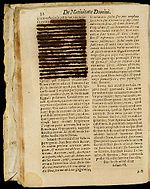
Milton's defence force of freedom of expression was grounded in a Protestant worldview. He idea that the English language people had the mission to work out the truth of the Reformation, which would lead to the enlightenment of all people. However, Milton likewise articulated the main strands of future discussions almost liberty of expression. By defining the scope of freedom of expression and "harmful" speech, Milton argued against the principle of pre-censorship and in favor of tolerance for a wide range of views.[74] Freedom of the printing ceased being regulated in England in 1695 when the Licensing Guild of 1643 was immune to expire afterwards the introduction of the Bill of Rights 1689 shortly later on the Glorious Revolution.[78] [79] The emergence of publications like the Tatler (1709) and the Spectator (1711) are credited for creating a 'bourgeois public sphere' in England that immune for a free exchange of ideas and information.
More governments attempted to centralize control equally the "menace" of printing spread.[80] The French crown repressed press and the printer Etienne Dolet was burned at the stake in 1546. In 1557 the British Crown thought to stem the flow of seditious and heretical books by chartering the Stationers' Company. The right to print was limited to the members of that society. 30 years later, the Star Chamber was chartered to curtail the "greate enormities and abuses" of "dyvers contentyous and disorderlye persons professinge the arte or mystere of pryntinge or selling of books". The correct to impress was restricted to ii universities and the 21 existing printers in the city of London, which had 53 printing presses. As the British crown took control of type founding in 1637, printers fled to holland. Confrontation with authority made printers radical and rebellious, with 800 authors, printers, and volume dealers beingness incarcerated in the Guardhouse in Paris before it was stormed in 1789.[80]
A succession of English thinkers was at the forefront of early discussion on a right to freedom of expression, amongst them John Milton (1608–74) and John Locke (1632–1704). Locke established the individual equally the unit of value and the bearer of rights to life, freedom, belongings and the pursuit of happiness. However, Locke's ideas evolved primarily around the concept of the right to seek salvation for i's soul. He was thus primarily concerned with theological matters. Locke neither supported a universal toleration of peoples nor freedom of spoken language; according to his ideas, some groups, such as atheists, should not be allowed.[81]

George Orwell statue at the headquarters of the BBC. A defence of free speech communication in an open up society, the wall behind the statue is inscribed with the words "If liberty means anything at all, it means the right to tell people what they practise not want to hear", words from George Orwell's proposed preface to Animal Farm (1945).[82]
By the second half of the 17th century philosophers on the European continent like Baruch Spinoza and Pierre Bayle developed ideas encompassing a more than universal attribute freedom of speech communication and toleration than the early English philosophers.[81] Past the 18th century the thought of freedom of speech was existence discussed past thinkers all over the Western world, especially by French philosophes like Denis Diderot, Businesswoman d'Holbach and Claude Adrien Helvétius.[83] The idea began to be incorporated in political theory both in theory too as exercise; the start state edict in history proclaiming complete liberty of speech was the i issued 4 December 1770 in Denmark-Norway during the regency of Johann Friedrich Struensee.[84] Yet Struensee himself imposed some small-scale limitations to this edict on seven October 1771, and it was fifty-fifty further express after the fall of Struensee with legislation introduced in 1773, although censorship was not reintroduced.[85]
John Stuart Mill (1806–1873) argued that without man freedom, in that location could exist no progress in science, constabulary, or politics, which according to Manufacturing plant, required free give-and-take of opinion. Factory'south On Liberty, published in 1859, became a archetype defence force of the right to liberty of expression.[74] Factory argued that truth drives out falsity, therefore the costless expression of ideas, true or false, should not be feared. Truth is not stable or fixed only evolves with time. Mill argued that much of what we one time considered true has turned out imitation. Therefore, views should not exist prohibited for their apparent falsity. Factory too argued that free discussion is necessary to prevent the "deep slumber of a decided stance". Discussion would drive the march of truth, and by considering false views, the basis of true views could exist re-affirmed.[86] Furthermore, Mill argued that an opinion only carries intrinsic value to the possessor of that opinion, thus silencing the expression of that opinion is an injustice to a basic human right. For Mill, the merely instance in which speech can be justifiably suppressed is to prevent harm from a clear and direct threat. Neither economical or moral implications nor the speaker's own well-being would justify suppression of spoken communication.[87]
In her 1906 biography of Voltaire, Evelyn Beatrice Hall coined the following judgement to illustrate Voltaire's behavior: "I disapprove of what y'all say, but I will defend to the death your right to say it".[88] Hall's quote is often cited to depict the principle of freedom of speech.[88] Noam Chomsky stated, "If you believe in freedom of spoken communication, you believe in freedom of speech for views you don't like. Dictators such as Stalin and Hitler, were in favor of freedom of speech for views they liked only. If you're in favor of liberty of speech, that means you're in favor of freedom of speech precisely for views you despise".[89] Lee Bollinger argues that "the complimentary spoken language principle involves a special act of carving out i area of social interaction for extraordinary cocky-restraint, the purpose of which is to develop and demonstrate a social chapters to control feelings evoked by a host of social encounters". Bollinger argues that tolerance is a desirable value, if not essential. However, critics argue that society should be concerned by those who directly deny or advocate, for example, genocide (run into limitations above).[90]
Equally chairman of the London-based PEN International, a club which defends freedom of expression and a gratis press, English author H. G. Wells met with Stalin in 1934 and was hopeful of reform in the Soviet Union. Nonetheless, during their coming together in Moscow, Wells said, "the gratis expression of opinion—even of opposition opinion, I practise not know if you are prepared yet for that much freedom hither".[91]

The 1928 novel Lady Chatterley's Lover by D. H. Lawrence was banned for obscenity in several countries, including the United Kingdom, the U.s.a., Australia, Canada, and India. In the belatedly 1950s and early 1960s, it was the subject of landmark court rulings that saw the ban for obscenity overturned. Dominic Sandbrook of The Telegraph in the UK wrote, "Now that public obscenity has become commonplace, it is difficult to recapture the atmosphere of a club that saw fit to ban books such as Lady Chatterley's Lover because it was likely to 'deprave and corrupt' its readers".[92] Fred Kaplan of The New York Times stated the overturning of the obscenity laws "prepare off an explosion of free spoken communication" in the U.S.[93] The 1960s as well saw the Free Speech Move, a massive long-lasting student protest on the campus of the University of California, Berkeley during the 1964–65 academic twelvemonth.[94]
In contrast to Anglophone nations, France was a haven for literary liberty.[95] The innate French regard for the mind meant that France was disinclined to punish literary figures for their writing, and prosecutions were rare.[95] While it was prohibited everywhere else, James Joyce's Ulysses was published in Paris in 1922. Henry Miller'due south 1934 novel Tropic of Cancer (banned in the U.Due south. until 1963) and Lawrence'south Lady Chatterley's Lover were published in France decades earlier they were available in the respective authors' home countries.[95]
In 1964 comedian Lenny Bruce was arrested in the U.S. due to complaints over again about his use of various obscenities. A iii-judge panel presided over his widely publicized 6-month trial. He was establish guilty of obscenity in November 1964. He was sentenced on 21 December 1964, to iv months in a workhouse.[96] He was prepare gratuitous on bail during the appeals procedure and died before the appeal was decided. On 23 Dec 2003, thirty-seven years after Bruce'due south death, New York Governor George Pataki granted him a posthumous pardon for his obscenity conviction.[97]
In the United States, the correct to liberty of expression has been interpreted to include the right to take and publish photographs of strangers in public areas without their permission or knowledge.[98] [99] This is not the case worldwide.
Offences [edit]
In some countries, people are not allowed to talk about certain things. Doing and then constitutes an offence. For example, Kingdom of saudi arabia is responsible for executing announcer Jamal Khashoggi in 2018. As he entered the Saudi embassy in Turkey, a team of Saudi assassins killed him.[100] Some other Saudi writer, Raif Badawi, was arrested in 2012 and lashed.[101]
Freedom of speech on higher campuses [edit]
In July 2014, the University of Chicago released the "Chicago Argument," a gratis spoken communication policy statement designed to combat censorship on campus. This statement was after adopted past a number of top-ranked universities including Princeton University, Washington University in St. Louis, Johns Hopkins University, and Columbia University.[102] [103]
Commentators such as Vox'southward Zack Beauchamp and Chris Quintana, writing in The Chronicle of Higher Education, accept disputed the assumption that college campuses are facing a "costless-speech crunch".[104] [105]
See besides [edit]
- Academic freedom
- Artistic freedom
- The Confessionals
- Cancel culture
- Civil and political rights
- Digital rights
- Election silence
- Everybody Depict Mohammed 24-hour interval
- Forced or compelled speech
- Costless speech communication fights
- Freedom of thought
- Glasnost
- Global Network Initiative
- Hate spoken communication
- Heckler'south veto
- IFEX (organisation)
- Illegal number
- Je suis Charlie
- Jyllands-Posten Muhammad cartoons controversy
- Jamal Khashoggi
- Legality of Holocaust deprival
- Post–World War 2 legality of Nazi flags
- Strafgesetzbuch department 86a
- Verbotsgesetz 1947
- Bans on communist symbols
- Lolicon/Shotacon
- Legal status of drawn pornography depicting minors
- Simulated kid pornography
- Market for loyalties theory
- Media transparency
- No Platform
- Open court principle
- Paradox of tolerance
- Parrhesia
- Photography Is Non a Law-breaking
- Pirate Party
- Political correctness
- Rights
- Safety of journalists
- Stanley v. Georgia
- Symbolic speech
- Victimless criminal offence
References [edit]
- ^ "Universal Declaration of Human Rights". www.un.org. vi Oct 2015. Archived from the original on 2 October 2019. Retrieved 2 October 2020.
- ^ Fee, James Five. (January 1973). "Book reviews". Today'south Speech. 21 (i): 45–48. doi:10.1080/01463377309369084. ISSN 0040-8573.
- ^ "Commodity 19". International Covenant on Civil and Political Rights. Part of the Un High Commissioner for Human Rights; adopted and opened for signature, ratification and accretion by Un General Assembly resolution 2200A (XXI) of xvi December 1966, entry into strength 23 March 1976. 23 March 1976. Archived from the original on v July 2008. Retrieved 13 March 2014.
- ^ a b van Mill, David (ane Jan 2016). Zalta, Edward North. (ed.). The Stanford Encyclopedia of Philosophy (Fall 2016 ed.). Archived from the original on 18 March 2019. Retrieved 12 October 2016.
- ^ "Human being Rights Measurement Initiative – The showtime global initiative to track the human being rights operation of countries". humanrightsmeasurement.org . Retrieved 9 March 2022.
- ^ "Right to opinion and expression - HRMI Rights Tracker". rightstracker.org . Retrieved 9 March 2022.
- ^ a b c Smith, David (5 February 2006). "Timeline: a history of free speech". The Guardian. London. Archived from the original on 29 August 2013. Retrieved 2 May 2010.
- ^ Raaflaub, Kurt; Ober, Josiah; Wallace, Robert (2007). Origins of commonwealth in aboriginal Greece . Academy of California Press. p. 65. ISBN978-0-520-24562-4.
- ^ Grand. P. Charlesworth (March 1943). "Liberty of Speech in Republican Rome". The Classical Review. The Classical Association. 57 (1): 49. doi:ten.1017/s0009840x00311283. S2CID 162366362. Archived from the original on 29 June 2011. Retrieved 4 March 2011.
- ^ Ofir Haivry and Yoram Hazony: What Is Conservatism? Archived 7 April 2021 at the Wayback Machine American Affairs Summer 2017 / Book I, Number 2.
- ^ "Pecker of Rights 1689". Parliament U.k.. Archived from the original on 12 March 2017. Retrieved thirty Apr 2019.
- ^ Williams, Due east. Northward. (1960). The Eighteenth-Century Constitution. 1688–1815. Cambridge Academy Press. pp. 26–29. OCLC 1146699.
- ^ ""The Liberty of the Printing Act", Sveriges Riksdag". Archived from the original on 30 September 2007.
- ^ Fortress Europe? – Circular Letter. "FECL 15 (May 1993): The Swedish Tradition of Freedom of Printing". Archived from the original on viii March 2016. Retrieved xiv March 2016.
{{cite web}}: CS1 maint: unfit URL (link) - ^ "The World'south First Freedom of Data Human activity (Sweden/Republic of finland 1766)". Scribd. Archived from the original on 15 December 2013. Retrieved 14 March 2016.
- ^ "Sweden". Archived from the original on vi April 2019. Retrieved xx May 2020.
- ^ "Liberty of Speech". HISTORY. Archived from the original on nine March 2020. Retrieved 23 February 2020.
- ^ Arthur Due west. Diamond Law Library at Columbia Police force School (26 March 2008). "Declaration of the Rights of Man and of the Citizen". Hrcr.org. www.hrcr.org. Archived from the original on vi June 2013. Retrieved 25 June 2013.
- ^ United Nations (10 September 1948). "The Universal Declaration of Human Rights". United nations.org. world wide web.un.org. Archived from the original on 3 July 2017. Retrieved 25 June 2013.
- ^ a b c d e Andrew Puddephatt, Liberty of Expression, The essentials of Man Rights, Hodder Arnold, 2005, p. 128
- ^ a b c Brett, Sebastian (1999). Limits to tolerance: freedom of expression and the public debate in Chile. Human being Rights Sentinel. p. xxv. ISBN978-1-56432-192-3. Archived from the original on 9 July 2021. Retrieved eleven Nov 2020.
- ^ New Yorker, xiv May 1960, p. 109
- ^ Sanders, Karen (2003). Ethics & Journalism. Sage. p. 68. ISBN978-0-7619-6967-9. Archived from the original on fifteen February 2022. Retrieved 25 November 2018.
- ^ Nossel, Suzanne (28 July 2020). Dare to Speak: Defending Free Speech for All. HarperCollins. p. x. ISBN978-0-06-296606-3. Archived from the original on fifteen February 2022. Retrieved 8 March 2021.
- ^ Marlin, Randal (2002). Propaganda and the Ethics of Persuasion. Broadview Press. pp. 226–27. ISBN978-1551113760. Archived from the original on fifteen August 2021. Retrieved 11 November 2020.
- ^ Marlin, Randal (2002). Propaganda and the Ethics of Persuasion. Broadview Press. p. 226. ISBN978-1551113760. Archived from the original on 15 August 2021. Retrieved 11 November 2020.
- ^ Marlin, Randal (2002). Propaganda and the Ethics of Persuasion. Broadview Printing. pp. 228–29. ISBN978-1551113760. Archived from the original on xv August 2021. Retrieved 11 November 2020.
- ^ "A Decade of Measuring the Quality of Governance" (PDF). World Bank. Archived from the original (PDF) on 8 April 2008.
- ^ Matschke, Alexander (25 December 2014). "Freedom of expression promotes democracy". D+C Development and Cooperation. Archived from the original on 2 April 2015. Retrieved 26 March 2015.
- ^ Marlin, Randal (2002). Propaganda and the Ethics of Persuasion. Broadview Press. p. 229. ISBN978-1551113760. Archived from the original on 15 Baronial 2021. Retrieved eleven November 2020.
- ^ Church members enter Canada, aiming to lookout charabanc victim's funeral Archived 15 Feb 2022 at the Wayback Machine, CBC News, eight August 2008.
- ^ a b c d "Freedom of Speech". Stanford Encyclopedia of Philosophy. 17 April 2008. Archived from the original on 23 March 2019. Retrieved 29 May 2011.
- ^ Manufacturing plant, John Stuart (1859). "Introductory". On Freedom (4th ed.). London: Longman, Roberts & Green (published 1869). para. 5. Archived from the original on xiv November 2019. Retrieved 8 September 2016.
Society tin and does execute its ain mandates ... it practises a social tyranny more formidable than many kinds of political oppression, since, though not usually upheld past such extreme penalties, information technology leaves fewer ways of escape, penetrating much more securely into the details of life, and enslaving the soul itself. Protection, therefore, against the tyranny of the magistrate is not enough...
- ^ Mill, John Stuart (1859). "Of the Liberty of Thought and Word". On Liberty (4th ed.). London: Longman, Roberts & Dark-green (published 1869). para. nineteen. Archived from the original on 14 November 2019. Retrieved 8 September 2016.
In respect to all persons simply those whose pecuniary circumstances make them independent of the good volition of other people, stance, on this subject, is as efficacious as constabulary; men might too be imprisoned, as excluded from the means of earning their staff of life.
- ^ Ten Cate, Irene 1000. (2010). "Oral communication, Truth, and Freedom: An Exam of John Stuart Factory's and Justice Oliver Wendell Holmes's Gratis Speech Defenses". Yale Journal of Constabulary & the Humanities. 22 (one). Article 2. Archived from the original on 24 September 2016. Retrieved 8 September 2016.
[A] central statement for freedom of speech in On Liberty is that in club to maximize the benefits a guild can gain ... it must permanently commit to restraining dominant groups from their natural inclination to demand conformity.
- ^ Wragg, Paul (2015). "Free Speech Rights at Work: Resolving the Differences between Practice and Liberal Principle". Industrial Constabulary Journal. Oxford Academy Press. 44 (1): 11. doi:10.1093/indlaw/dwu031.
Comparing may exist made between Mill's 'tyrannical majority' and the employer who dismisses an employee for expression that it dislikes on moral grounds. The protection of employer action in these circumstances evokes Mill'due south business organization about state tolerance of coercive means to ensure conformity with orthodox moral viewpoints and so nullify unorthodox ones.
- ^ a b Harcourt. "Conclusion". The Collapse of the Damage Principle. Archived from the original on 4 March 2016. Retrieved 7 September 2015.
- ^ Doomen 2014, pp. 111, 112.
- ^ Kenneth Einar Himma. "Philosophy of Law". Net Encyclopedia of Philosophy. Archived from the original on 14 September 2008. Retrieved 13 March 2014.
- ^ "Italian Parliament introduces holocaust denial legislation". UPI. Archived from the original on 15 March 2020. Retrieved 28 June 2019.
- ^ Chase Winter (26 October 2018). "Calling Prophet Muhammad a pedophile does not fall within freedom of speech: European court". Deutsche Welle. Archived from the original on 27 Oct 2018. Retrieved 27 October 2018.
An Austrian adult female'southward conviction for calling the Prophet Muhammad a pedophile did non violate her freedom of speech, the European Court of Human Rights ruled Thursday.
- ^ Lucia I. Suarez Sang (26 October 2018). "Defaming Muhammad does not autumn under purview of gratuitous speech communication, European court rules". Fox News. Archived from the original on 26 October 2018. Retrieved 27 October 2018.
The liberty of speech does not extend to include defaming the prophet of Islam, the European Court of Human being rights ruled Thursday.
- ^ Bojan Pancevski (26 Oct 2018). "Europe Courtroom Upholds Ruling Against Woman Who Insulted Islam". The Wall Street Periodical. Archived from the original on 26 October 2018. Retrieved 27 October 2018.
Europe'due south highest human rights court ruled on Friday that disparagement of religious doctrines such every bit insulting the Prophet Muhammad isn't protected past freedom of expression and can be prosecuted.
- ^ Brandenburg v. Ohio, 395 U.S. 444 (1969)
- ^ Jasper 1999, p. 32. sfn mistake: no target: CITEREFJasper1999 (assistance)
- ^ Brandenburg, at 447
- ^ Brandenburg, at 450–01
- ^ Lewis 2007, p. 124.
- ^ "ABA Division for Public Pedagogy: Students: Debating the "Mighty Ramble Opposites": Detest Spoken language Argue". www.americanbar.org. Archived from the original on xiii October 2016. Retrieved 12 October 2016.
- ^ Emanuel, Steven L. (25 March 2020). Emanuel Crunchtime for Constitutional Police force. Wolters Kluwer Constabulary & Business. pp. 153–154. ISBN978-i-5438-0727-1. Archived from the original on 15 February 2022. Retrieved 18 September 2021.
- ^ Marcotte, John (one May 2007). "gratuitous speech flag". Badmouth. Archived from the original on 4 May 2007. Retrieved 27 October 2017.
- ^ Glanville, Jo (17 Nov 2008). "The big business concern of net censorship". The Guardian. London. Archived from the original on 28 January 2013. Retrieved 26 March 2014.
- ^ Godwin, Mike (2003). Cyber Rights: Defending Complimentary Speech in the Digital Historic period. MIT Printing. pp. 349–52. ISBN0-262-57168-4.
- ^ a b Rowland, Diane (2005). Information technology Constabulary. Routledge-Cavendish. pp. 463–65. ISBN978-1859417560.
- ^ Klang, Mathias; Murray, Andrew (2005). Human Rights in the Digital Age. Routledge. p. ane. ISBN978-1-904385-31-8. Archived from the original on 15 August 2021. Retrieved eleven November 2020.
- ^ Guibault, Lucy; Hugenholtz, Bernt (2006). The futurity of the public domain: identifying the commons in information law. Kluwer Law International. p. 1. ISBN9789041124357. Archived from the original on xv February 2022. Retrieved 25 November 2018.
- ^ Clarke, Ian; Miller, Scott One thousand.; Hong, Theodore W.; Sandberg, Oskar; Wiley, Brandon (2002). "Protecting Free Expression Online with Freenet" (PDF). Cyberspace Computing. IEEE. pp. forty–49. Archived (PDF) from the original on 11 October 2017. Retrieved 15 Oct 2008.
- ^ Pauli, Darren (14 January 2008). "Industry rejects Australian gov't sanitized Internet measure". The Industry Standard. Archived from the original on 12 September 2012.
- ^ Martin, Robert; Adam, G. Stuart (1994). A Sourcebook of Canadian Media Law. McGill-Queen's Press. pp. 232–34. ISBN0886292387.
- ^ Deibert, Robert; Palfrey, John G; Rohozinski, Rafal; Zittrain, Jonathan (2008). Access denied: the practice and policy of global Net filtering . MIT Press. ISBN978-0262541961.
- ^ "Our Mission". Global Internet Liberty Consortium. Archived from the original on 27 September 2017.
- ^ "Internet Enemies" (PDF). Paris: Reporters Without Borders. March 2011. Archived from the original (PDF) on 15 March 2011.
- ^ Watts, Jonathan (20 February 2006). "State of war of the words". The Guardian. London. Archived from the original on 15 February 2022. Retrieved 11 December 2016.
- ^ "Ii. How Censorship Works in People's republic of china: A Cursory Overview". Human Rights Sentry. Archived from the original on 22 April 2015. Retrieved 30 August 2006.
- ^ "Chinese Laws and Regulations Regarding Internet". Archived from the original on 20 Feb 2012.
- ^ a b Wu, Tim (1 September 2017). "Is the Beginning Amendment Obsolete?". Knight First Amendment Institute at Columbia University. Archived from the original on 21 September 2020. Retrieved 23 September 2020.
- ^ Yaffa, Joshua (7 September 2020). "Is Russian Meddling as Unsafe as We Call back?". The New Yorker. Archived from the original on 14 Feb 2021. Retrieved 21 September 2020.
- ^ "What things regulate speech" (PDF). Archived (PDF) from the original on 27 November 2020. Retrieved 12 Jan 2021.
- ^ "The Menace of Unreality: How the Kremlin Weaponizes Information, Culture and Money". Archived from the original on 12 January 2021. Retrieved 12 Jan 2021.
- ^ a b de Sola Puddle, Ithiel (1983). Technologies of freedom. Harvard University Press. p. 14. ISBN978-0-674-87233-ii.
- ^ a b c MacQueen, Hector L; Waelde, Charlotte; Laurie, Graeme T (2007). Contemporary Intellectual Property: Law and Policy. Oxford University Press. p. 34. ISBN978-0-19-926339-4. Archived from the original on 15 February 2022. Retrieved 11 November 2016.
- ^ "6. Henric van Cuyck, Bishop of Roermond (1546–1609). Panegyricae orationes septem. Louvain: Philippus Zangrius, 1596". Ecclesiastical Censorship, "Heresy and Error": The Ecclesiastical Censorship of Books, 1400–1800. Bridwell Library. 17 December 2000. Archived from the original on eight September 2012. Retrieved 26 June 2011.
- ^ Castillo, Anastasia (2010). Banned Books: Censorship in Eighteenth-Century England. GRIN Verlag. p. 12. ISBN978-3-640-71688-3. Archived from the original on 15 August 2021. Retrieved eleven Nov 2020.
- ^ a b c d eastward Sanders, Karen (2003). Ethics & Journalism. Sage. p. 66. ISBN978-0-7619-6967-9. Archived from the original on 15 February 2022. Retrieved 25 November 2018.
- ^ "13. John Milton (1608–1674). Areopagitica; A Speech of Mr. John Milton for the Liberty of Unlicenc'd Printing, to the Parlament of England. London: [s.due north.], 1644". Early Censorship in England, "Heresy and Fault": The Ecclesiastical Censorship of Books, 1400–1800. Bridwell Library. 17 December 2000. Archived from the original on v September 2012. Retrieved 26 June 2011.
- ^ "The index of expurgations". "Heresy and Error": The Ecclesiastical Censorship of Books, 1400–1800. Bridwell Library. 17 December 2000. Archived from the original on 8 September 2012. Retrieved 26 June 2011.
- ^ "52. Jacobus de Voragine (c. 1230–1298). Legenda aurea sanctorum. Madrid: Juan Garcia, 1688". The Index of Expurgations, "Heresy and Error": The Ecclesiastical Censorship of Books, 1400–1800. Bridwell Library. 17 December 2000. Archived from the original on 8 September 2012. Retrieved 26 June 2011.
- ^ Rayner, Gordon (vii October 2011). "Leveson Inquiry: British press freedom is a model for the globe, editor tells inquiry". The Telegraph. Telegraph Media Group Limited. Archived from the original on 7 October 2011. Retrieved 9 May 2018.
Mr Rusbridger said: "When people talk nearly licensing journalists or newspapers the instinct should be to refer them to history. Read well-nigh how licensing of the printing in U.k. was abolished in 1695.
- ^ Nelson, Fraser (24 November 2012). "David Blunkert warns MPs against regulating the Press". The Spectator. Archived from the original on 19 October 2017. Retrieved 9 May 2018.
Jeremy Paxman famously said he went into journalism after hearing that the relationship between a journalist and a politico was akin to that of a dog and a lamppost. Several MPs now want to replace this with a principle whereby MPs define the parameters nether which the printing operates – and "work together". Information technology is a hideous idea that must be resisted. The last time this happened was under the Licensing Order of 1643, which was immune to expire in 1695 after the introduction of the 1688 Bill of Rights shortly after the Glorious Revolution. As I wrote in my Daily Telegraph column yesterday, it's astonishing that so many Tory MPs should want to plough the clock dorsum 300 years.
- ^ a b de Sola Puddle, Ithiel (1983). Technologies of freedom. Harvard University Press. p. 15. ISBN978-0-674-87233-2.
- ^ a b Jonathan Israel (2002). Radical Enlightenment. Oxford University Printing. pp. 265–67.
- ^ Jennings, Martin (7 Nov 2017). "Orwell statue unveiled". BBC. Archived from the original on 14 December 2019. Retrieved seven Nov 2017.
- ^ Jonathan State of israel (2006). Enlightenment Contested. Oxford Academy Press. pp. 155ff, 781ff.
- ^ Jonathan State of israel (2010). A Revolution of the Heed . Princeton University Press. p. 76. ISBN9780691142005.
- ^ H. Arnold Barton (1986). Scandinavia in the Revolutionary Era – 1760–1815 . University of Minnesota Press. pp. ninety–91. ISBN9780816613922.
- ^ Sanders, Karen (2003). Ethics & Journalism. Sage. p. 67. ISBN978-0-7619-6967-9. Archived from the original on 15 Feb 2022. Retrieved 25 November 2018.
- ^ Warburton, Nigel (2009). Free Speech: A Very Short Introduction. Oxford. pp. 24–29. ISBN978-0-19-923235-2. Archived from the original on fifteen August 2021. Retrieved half dozen May 2020.
- ^ a b Boller, Jr., Paul F.; George, John (1989). They Never Said It: A Book of Fake Quotes, Misquotes, and Misleading Attributions. New York: Oxford University Press. pp. 124–26. ISBN0-19-505541-one.
- ^ Mark Achbar and Peter Wintonick (1992). Manufacturing Consent: Noam Chomsky and the Media.
- ^ Bollinger, Lee C. (1986). The Tolerant Club: Freedom of Spoken language and Extremist Spoken communication in America. Oxford Academy Press. ISBN0195040007.
- ^ Freedom of Speech in Russian federation: Politics and Media from Gorbachev to Putin. Taylor & Francis, 25. 2016. p. 142.
- ^ Sandbrook, Dominic (sixteen Oct 2010). "Lady Chatterley trial - 50 years on. The filthy book that set the states free and fettered usa forever". The Telegraph. Archived from the original on 11 January 2022. Retrieved 9 May 2018.
Though few and then could have realised it, a tiny but unmistakeable line runs from the novel Lawrence wrote in the late 1920s to an international pornography industry today worth more than than £26 billion a year. Now that public obscenity has become commonplace, it is hard to recapture the temper of a club that saw fit to ban books such as Lady Chatterley'south Lover because it was probable to "bastardize and corrupt" its readers. Although but half a century separates usa from Harold Macmillan's Britain, the earth of 1960 can easily seem similar ancient history. In a United kingdom when men still wore heavy grey suits, working women were still relatively rare and the Empire was nevertheless, merely, a going concern, D H Lawrence's book was only ane of many banned because of its threat to public morality.
- ^ Kaplan, Fred (20 July 2009). "The Day Obscenity Became Fine art". The New York Times. Archived from the original on 13 June 2018. Retrieved 9 May 2018.
TODAY is the 50th anniversary of the court ruling that overturned America's obscenity laws, setting off an explosion of free spoken language — and also, in hindsight, splashing cold water on the idea, much discussed during Sonia Sotomayor's Supreme Courtroom confirmation hearings, that judges are "umpires" rather than agents of social change.
- ^ * "Berkeley FSM | Gratis Speech Movement 50th Anniversary". fsm.berkeley.edu. Archived from the original on eight Baronial 2017. Retrieved 17 May 2019.
- ^ a b c "Muddy books and literary freedom: The Lady Chatterley publisher who trounce the censors". BBC. Archived from the original on 17 November 2021. Retrieved 17 November 2021.
- ^ "Lenny Bruce Gets iv Months In Jail". The New York Times. Archived from the original on 25 January 2021. Retrieved 13 December 2020.
- ^ Minnis, Glenn "Lenny Bruce Pardoned" Archived twenty October 2012 at the Wayback Car, CBS News/Associated Press, 23 December 2003. Retrieved viii September 2019
- ^ Kenworthy, Nib (Apr 2012). "Photography & Commencement Amendment". Newseum Institute. Archived from the original on 2 July 2019. Retrieved five April 2018.
- ^ "Photographers' Rights". aclu.org. American Civil Liberties Union. Archived from the original on 9 May 2018. Retrieved nine May 2018.
Taking photographs and video of things that are plainly visible in public spaces is a ramble right—and that includes transportation facilities, the outside of federal buildings, and constabulary and other government officials carrying out their duties. Unfortunately, police enforcement officers accept been known to ask people to stop taking photographs of public places. Those who fail to comply take sometimes been harassed, detained, and arrested. Other people take ended up in FBI databases for taking innocuous photographs of public places.
- ^ "Opinion | Jamal Khashoggi: What the Arab world needs nearly is costless expression". The Washington Mail service. 17 October 2018. Archived from the original on 20 October 2018. Retrieved 15 February 2022.
- ^ "The start l lashes: A Saudi activist'southward wife endures her husband'due south barbarous sentence". TheGuardian.com. 17 May 2016. Archived from the original on 30 December 2021. Retrieved 30 Dec 2021.
- ^ "Chicago Statement: Academy and Faculty Body Support". Burn down. 15 August 2019. Archived from the original on 27 August 2019. Retrieved 26 August 2019.
- ^ Lindsay, Tom. "35 Universities Prefer 'The Chicago Statement' On Free Speech--1,606 To Get". Forbes. Archived from the original on 26 August 2019. Retrieved 26 August 2019.
- ^ Beauchamp, Zack (31 August 2018). "The myth of a campus free oral communication crisis". Vox. Archived from the original on 1 March 2019. Retrieved 28 February 2019.
- ^ Quintana, Chris (xxx Apr 2018). "The Real Costless-Oral communication Crunch Is Professors Being Disciplined for Liberal Views, a Scholar Finds". The Chronicle of College Education. ISSN 0009-5982. Archived from the original on 1 March 2019. Retrieved 28 Feb 2019.
Further reading [edit]
- Curtis, Michael Kent (2000). Free Speech, "The People's Darling Privilege": Struggles for Freedom of Expression in American History. Duke University Press. ISBN0822325292.
- Doomen, Jasper (2014). Freedom and Equality in a Liberal Democratic State. Bruylant. ISBN9782802746232.
- Godwin, Mike (2003). Cyber Rights: Defending Free Speech in the Digital Age. MIT Press. ISBN0262571684.
- Grossman, Wendy Thousand. (1997). Cyberspace.wars. New York University Printing. ISBN0814731031.
- Kors, Alan Charles (2008). "Liberty of Speech". In Hamowy, Ronald (ed.). The Encyclopedia of Libertarianism. Thousand Oaks, CA: SAGE; Cato Institute. pp. 182–85. doi:10.4135/9781412965811.n112. ISBN978-1-4129-6580-4. LCCN 2008009151. OCLC 750831024.
- Lewis, Anthony (2007). Liberty for the Thought That We Hate: A Biography of the Start Amendment. Basic Books. ISBN9780465039173. OCLC 494134545.
- McLeod, Kembrew (2007). Freedom of Expression: Resistance and Repression in the Age of Intellectual Belongings. Lawrence Lessig (foreword). University of Minnesota Press. ISBN978-0816650316.
- Nelson, Samuel P. (2005). Across the First Subpoena: The Politics of Gratis Voice communication and Pluralism. The Johns Hopkins University Press. ISBN0801881730.
- Semeraro, Pietro (2009). Fifty'esercizio di un diritto. Giuffre Milano.
- Shaw, Caroline. "Freedom of expression and the palladium of British liberties, 1650–2000: A review essay" History Compass (October 2020) online
External links [edit]
- Article19.org, Global Entrada for Gratuitous Expression.
- Gratuitous Speech Contend, a research project of the Dahrendorf Program for the Study of Freedom at St Antony's College in the University of Oxford.
- Alphabetize on Censorship, an international organisation that promotes and defends the right to freedom of expression.
- Media Freedom Navigator: Media Liberty Indices at a Glance, Deutsche Welle Akademie.
- Special Rapporteur for Liberty of Expression, Arrangement of American States.
Source: https://en.wikipedia.org/wiki/Freedom_of_speech
0 Response to "definition of freedom of speech, and the freedom to believe what ones believes"
Post a Comment